What is the future like when the community itself has the agency to think and build futures?
What is the future like when the community itself has the agency to think and build futures?
This project is about understanding how people in the Nilgiris think about "development" in their lives, especially through the lens of livelihood opportunities created by tea plantations, tourism, and wildlife life conflicts in the context of Kotagiri town. By looking at the past and the challenges of the present and the hopes and aspirations of the future, I want to work together with people from the ground/stakeholders to imagine hopeful and emergent futures for the region. Visualizing these futures is important because it helps us figure out what needs to change now and how we can take steps together to shape a better tomorrow.
This project is about understanding how people in the Nilgiris think about "development" in their lives, especially through the lens of livelihood opportunities created by tea plantations, tourism, and wildlife life conflicts in the context of Kotagiri town. By looking at the past and the challenges of the present and the hopes and aspirations of the future, I want to work together with people from the ground/stakeholders to imagine hopeful and emergent futures for the region. Visualizing these futures is important because it helps us figure out what needs to change now and how we can take steps together to shape a better tomorrow.

Experiential Participatory Futures
Speculative Design
Qualitative Design Research
Learning Experience Design
Experiential Participatory Futures
Speculative Design
Qualitative Design Research
Learning Experience Design
My Role
Project Owner
(Solo Project)
Timeline
12 Weeks
Collaborators
Keystone Foundation
Collaborators
Keystone Foundation
What is this Workshop about?
Can "Development" Listen is a Speculative Time Travel Workshop + Research Tool based in Kotagiri that helps people understand , unpack, evaluate and imagine divergent futures through participatory processes.
through
Mapping Presents
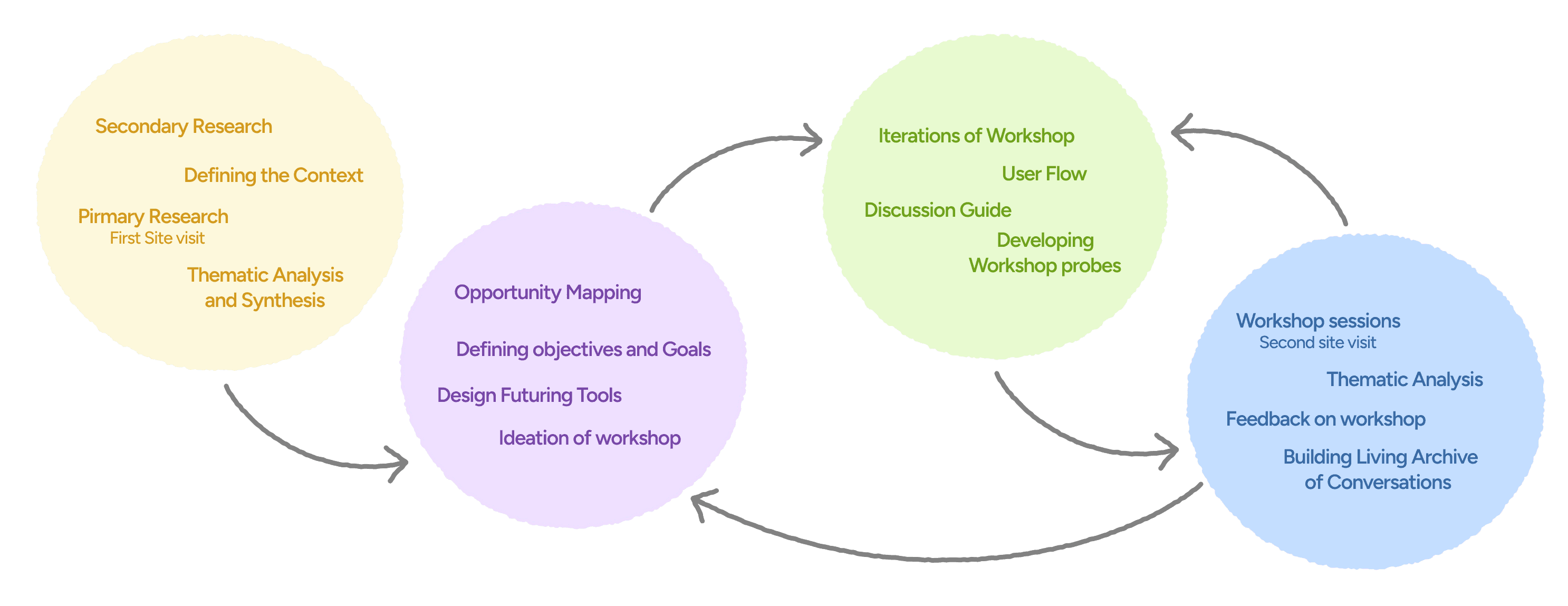
My Design Process
I had the chance to devote attention to every facet of the design process because I was fully in charge of the project. Although my design approach was by no means linear, I have included a summary of the type of work I completed for the project here.
Research and Development

"Why did my parents leave our hometown for Mumbai?"
My Personal experiences of sister's migration to USA, the seek for a good high paying job, aspirations for growth, reveal how Development operates as both intimate choice and systemic logic.
This inquiry started with to interrogate: What am I learning to want? Is upward mobility genuine progress, or predetermined narrative? Development emerges as simultaneously personal aspiration and collective politics, shaping individuals across diverse contexts, creating a situated lexicons that structure both personal trajectories and societal futures.
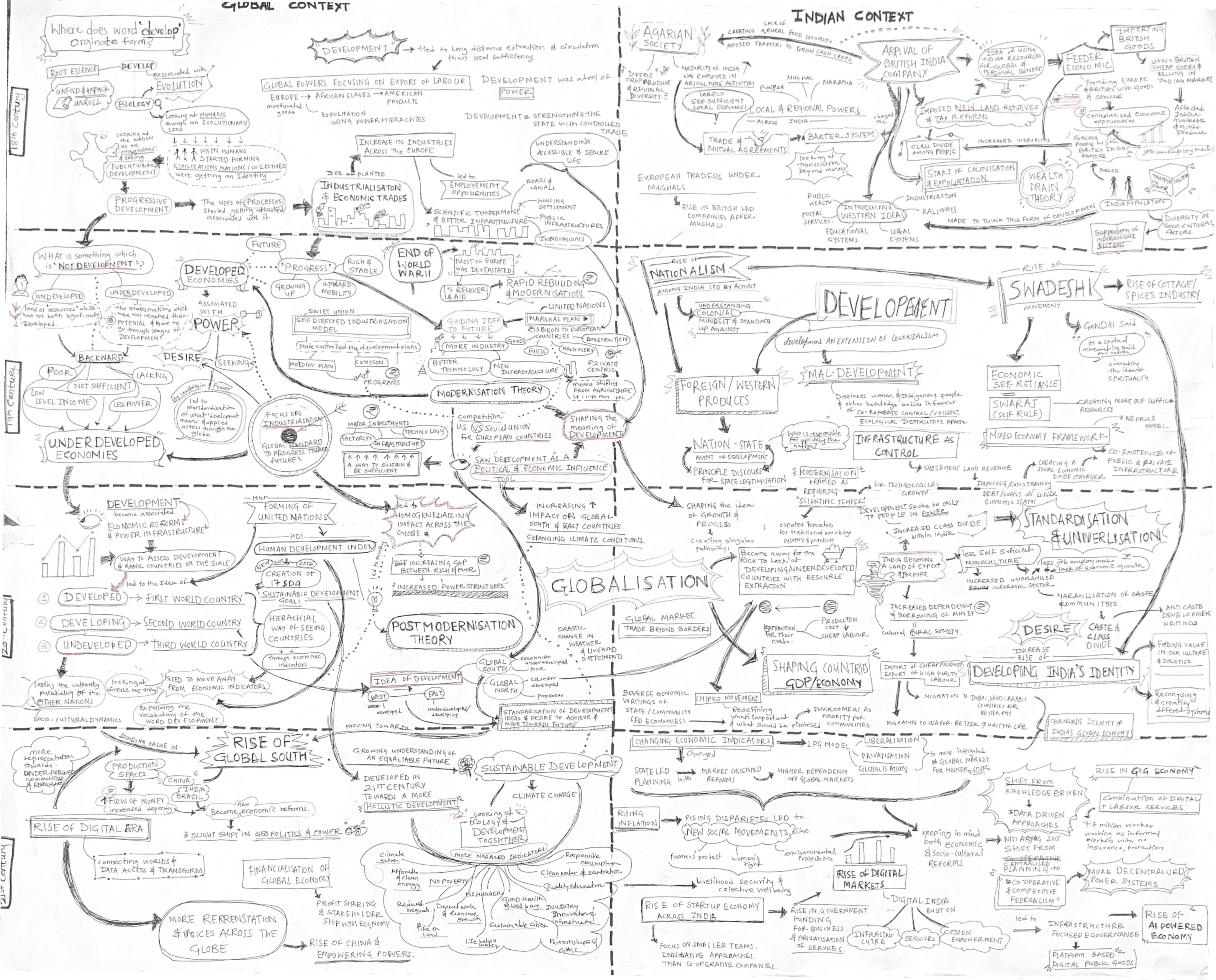

Development, as systemic and global, connects to every individual, shaping its lexicon through the very realities it constrains.
Can I map place-specific meanings first, then trace the diverse realities it can connect to, to then understand the systems it creates? This will reveal how one specific context interpret and negotiate dominant narratives of development and different futures development promises?
Niligirs as the context
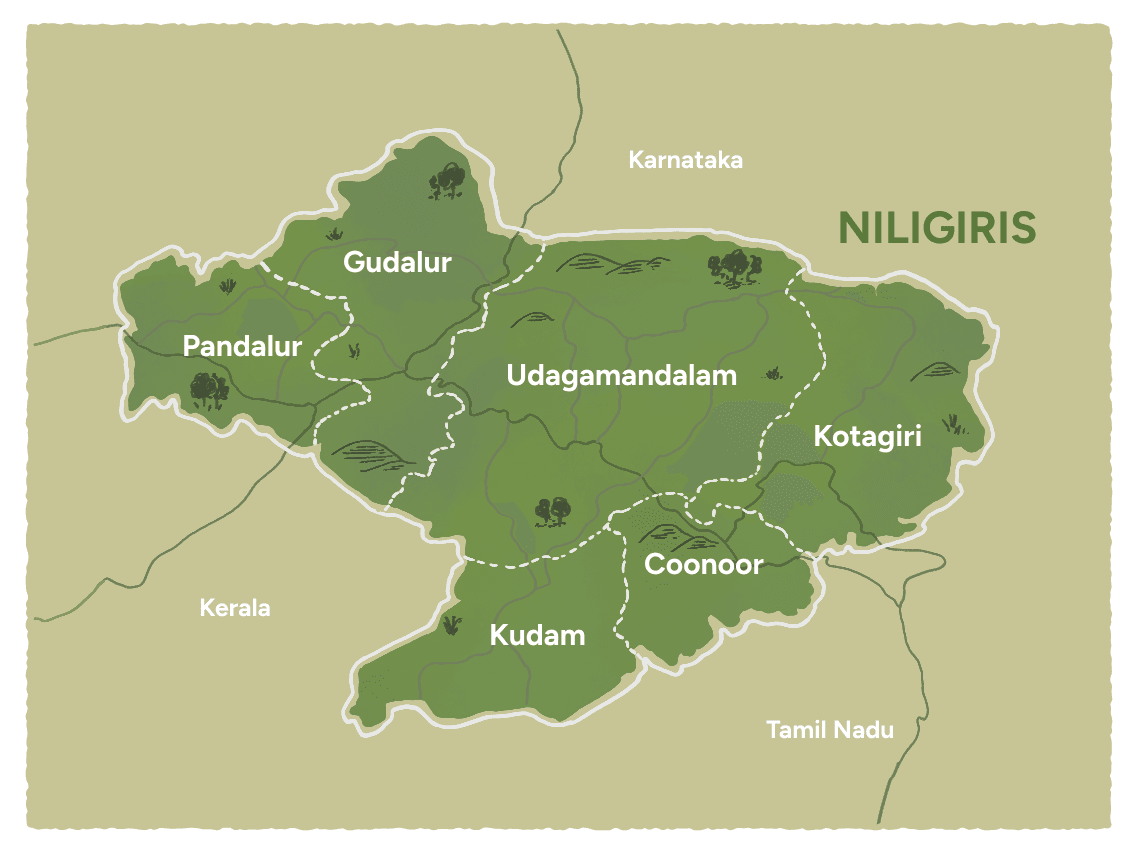
The Nilgiris Biosphere Reserve, India's first UNESCO-designated reserve spanning Tamil Nadu, Karnataka, and Kerala, (where each state maintains seperate regulations), encompasses 5,520 km² of ecological diversity across seven protected areas, multiple elephant corridors, cores, and buffers from Sathyamangalam, Bandipur, and Mudumalai National Parks. Home to Toda, Irula, and other Adivasi communities alongside 3,300 flowering plant species (132 endemic) and fauna like Nilgiri Tahr, the landscape bears diverse habitats which are constantly being shaped by decades of Colonization and Modernization.
State imperatives safeguard Nilgiris' ecological heritage while changing global demands for development initiatives to grow, create contested landscape of imaginaries among resident communities.
This raises the question,
In ecologically sensitive zones, what parameters assess and legitimize "Development"?
Secondary Research
Being an outsider, review through academic literature, news media and public writing became a way to first map how “development” in the Nilgiris is already being narrated, debated and decided.
This review traced dominant narratives across time, situating them in the region’s colonial and postcolonial histories while attending to how they surface in present.
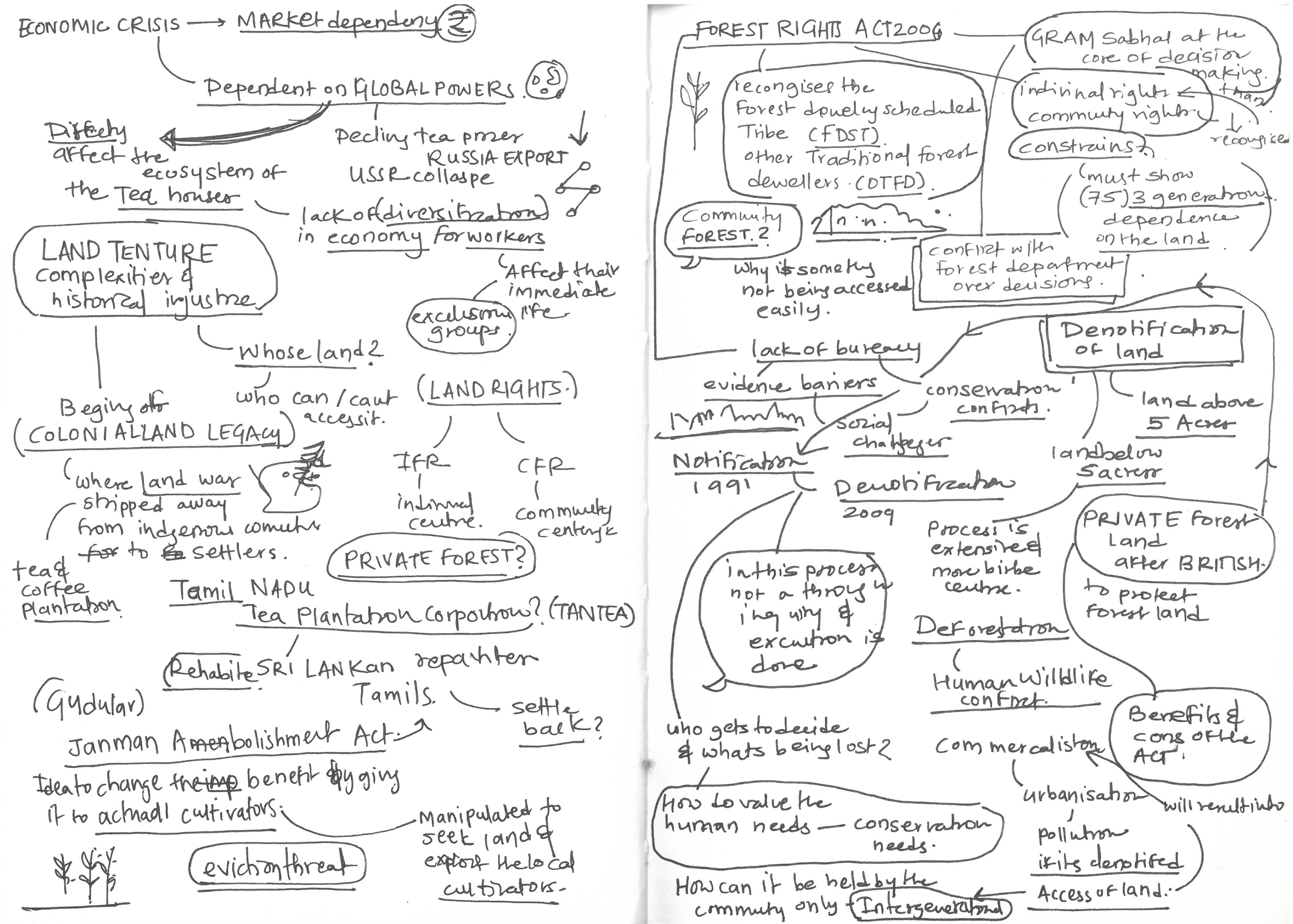
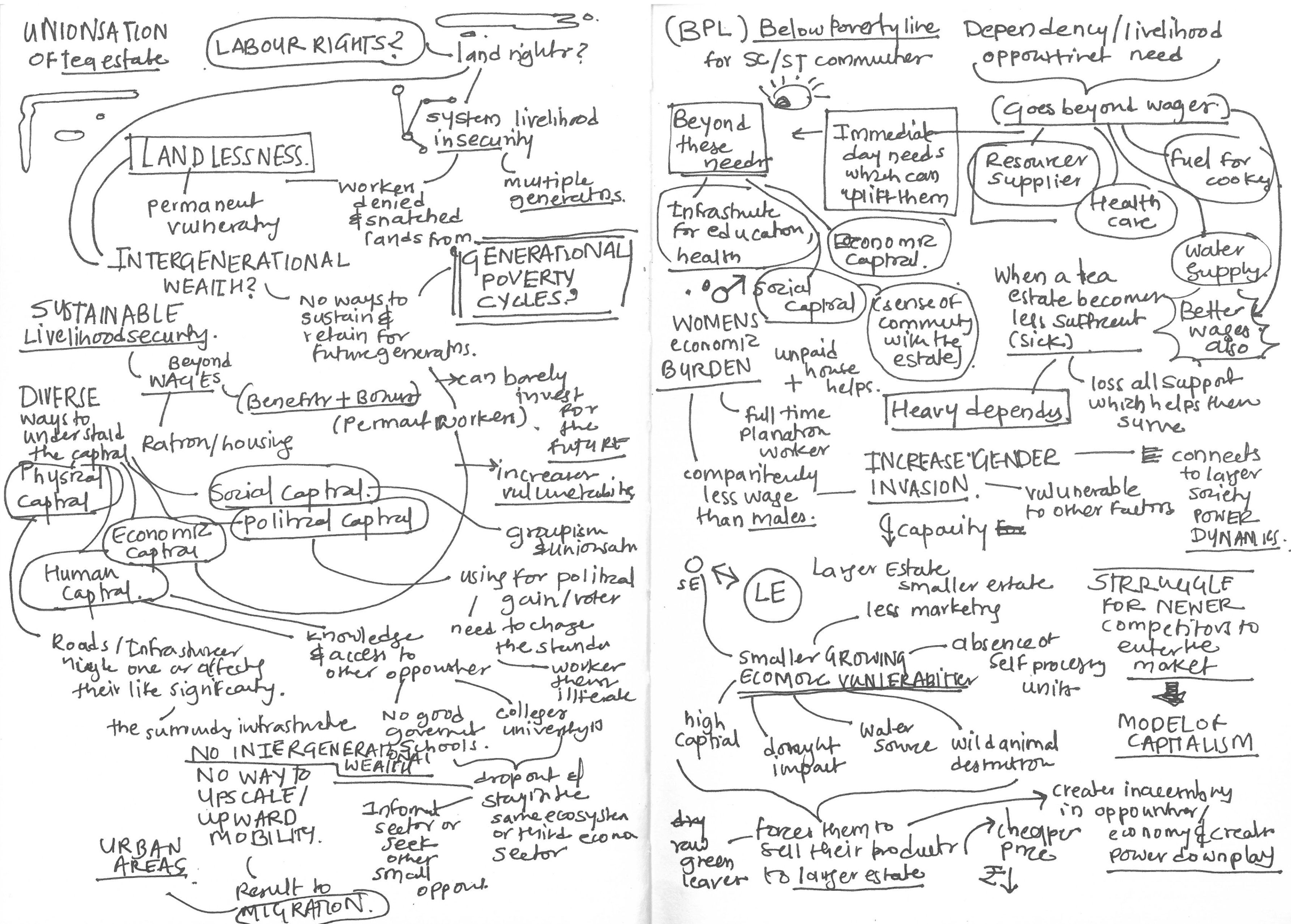
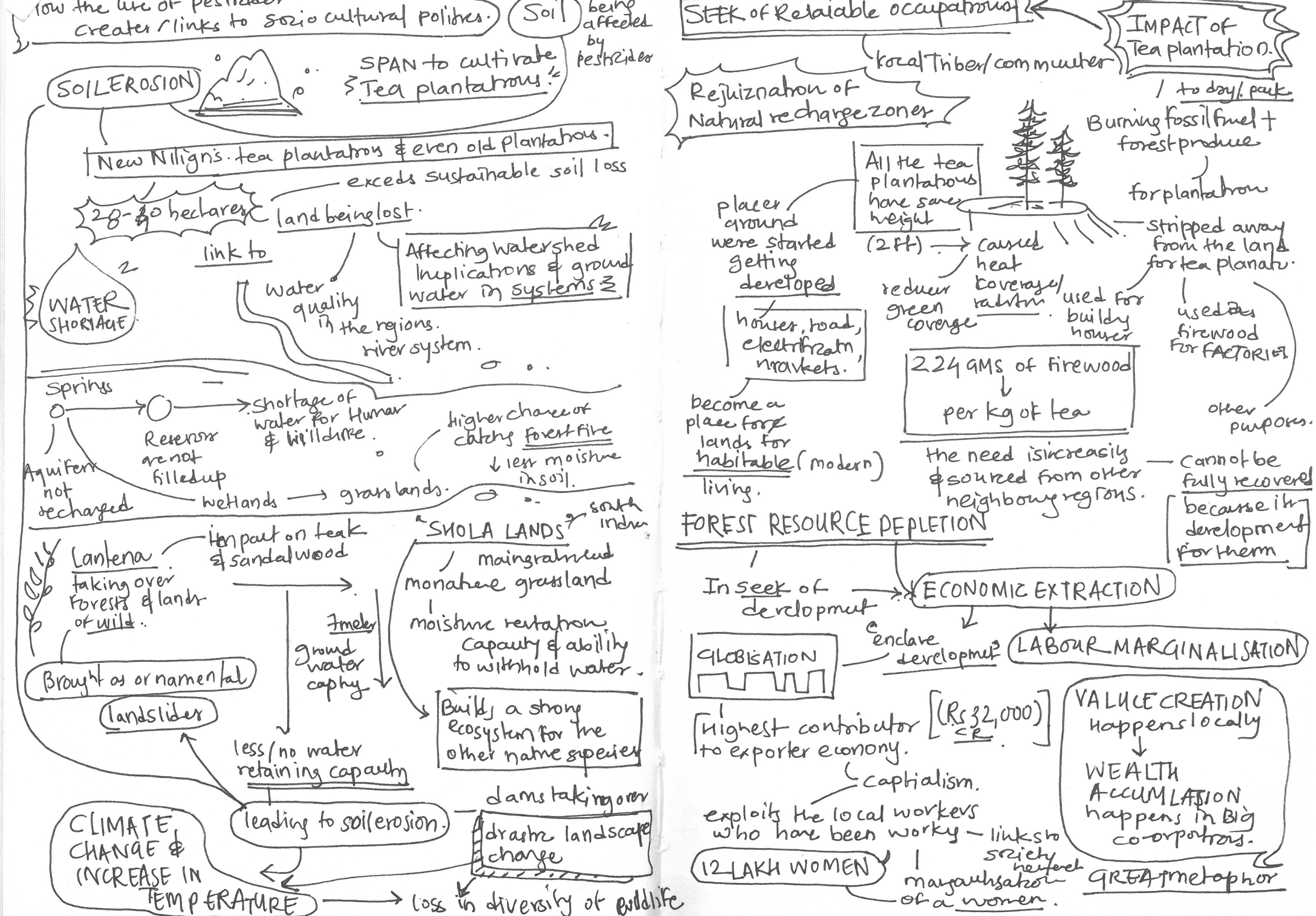
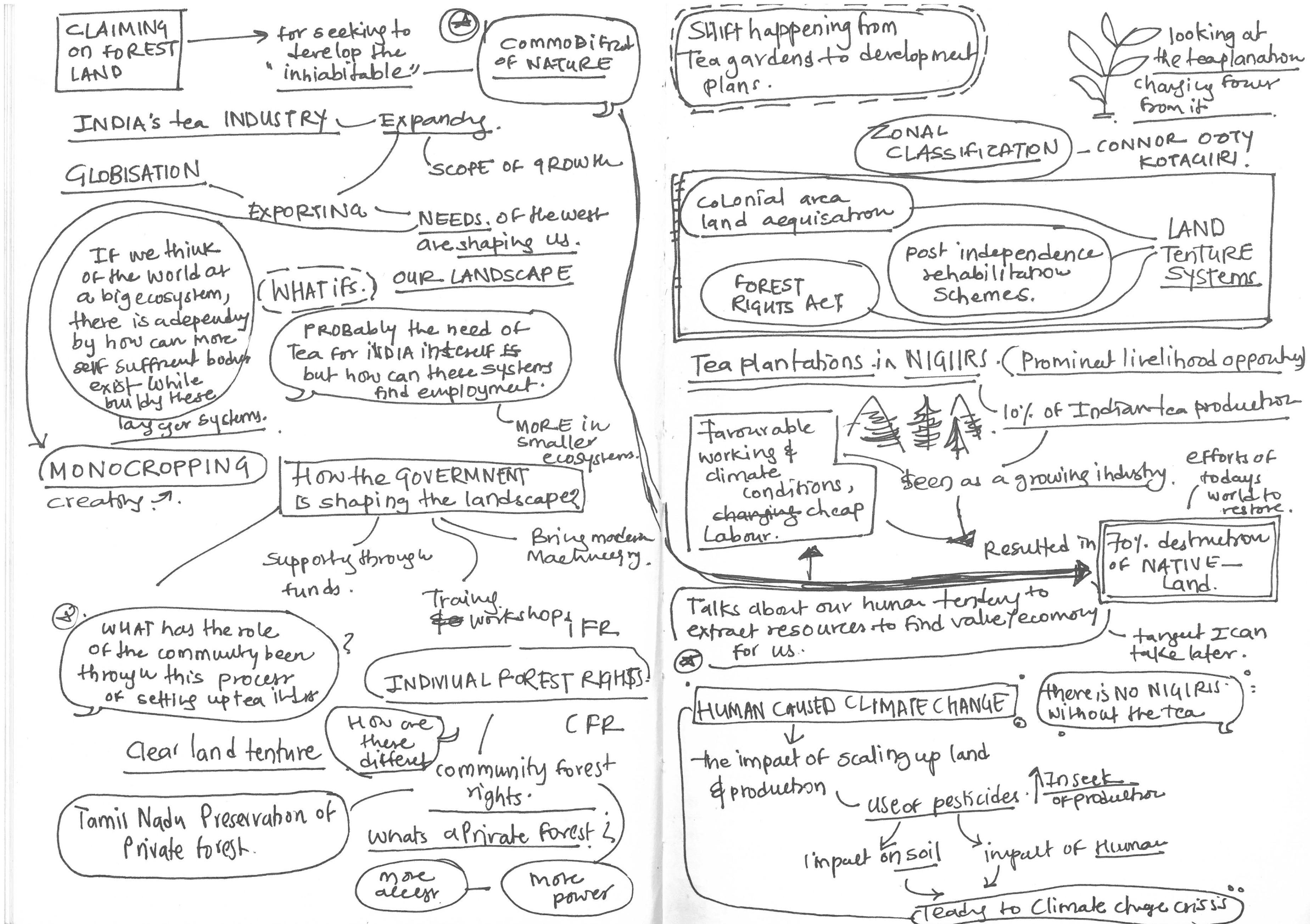
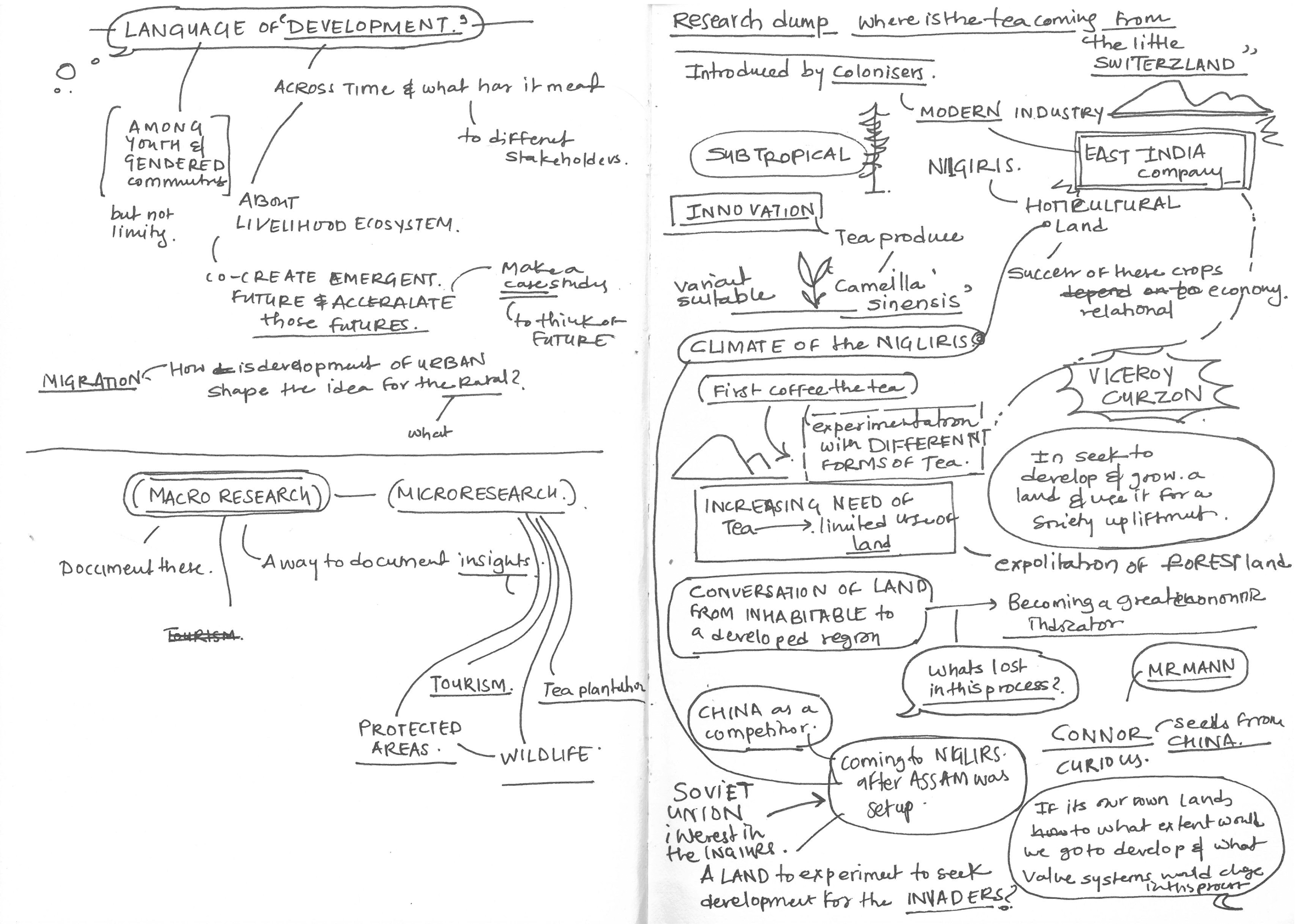
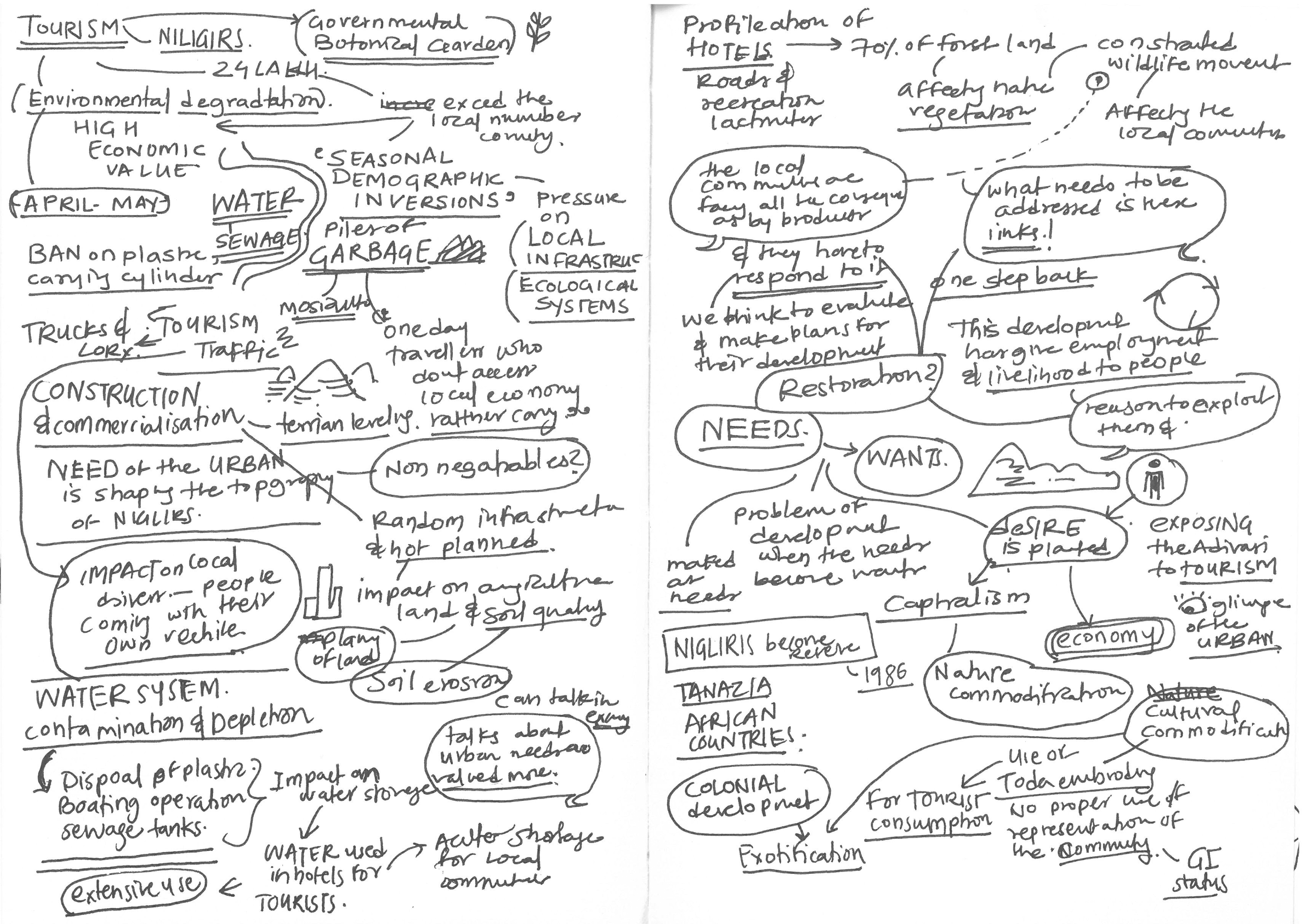
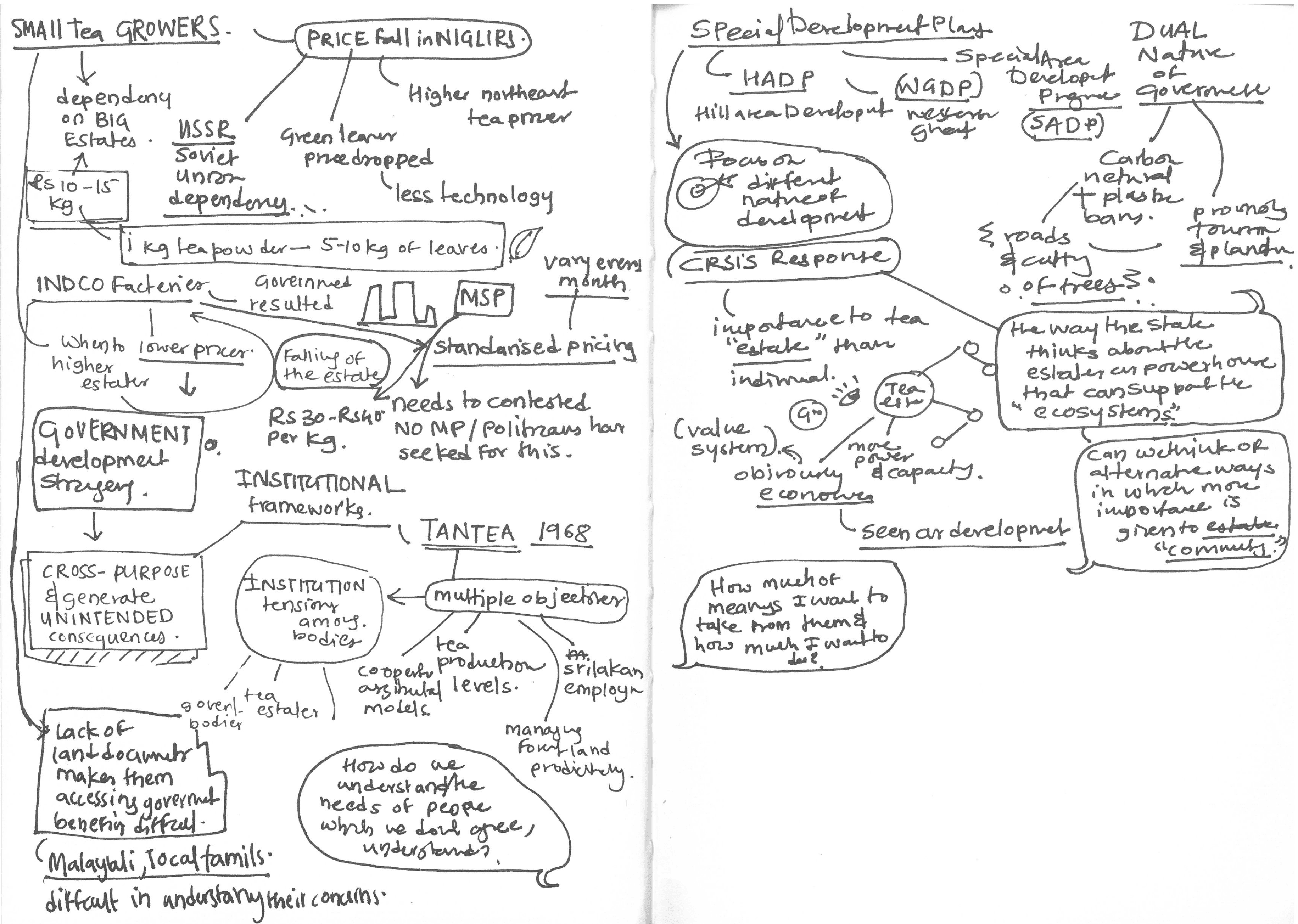
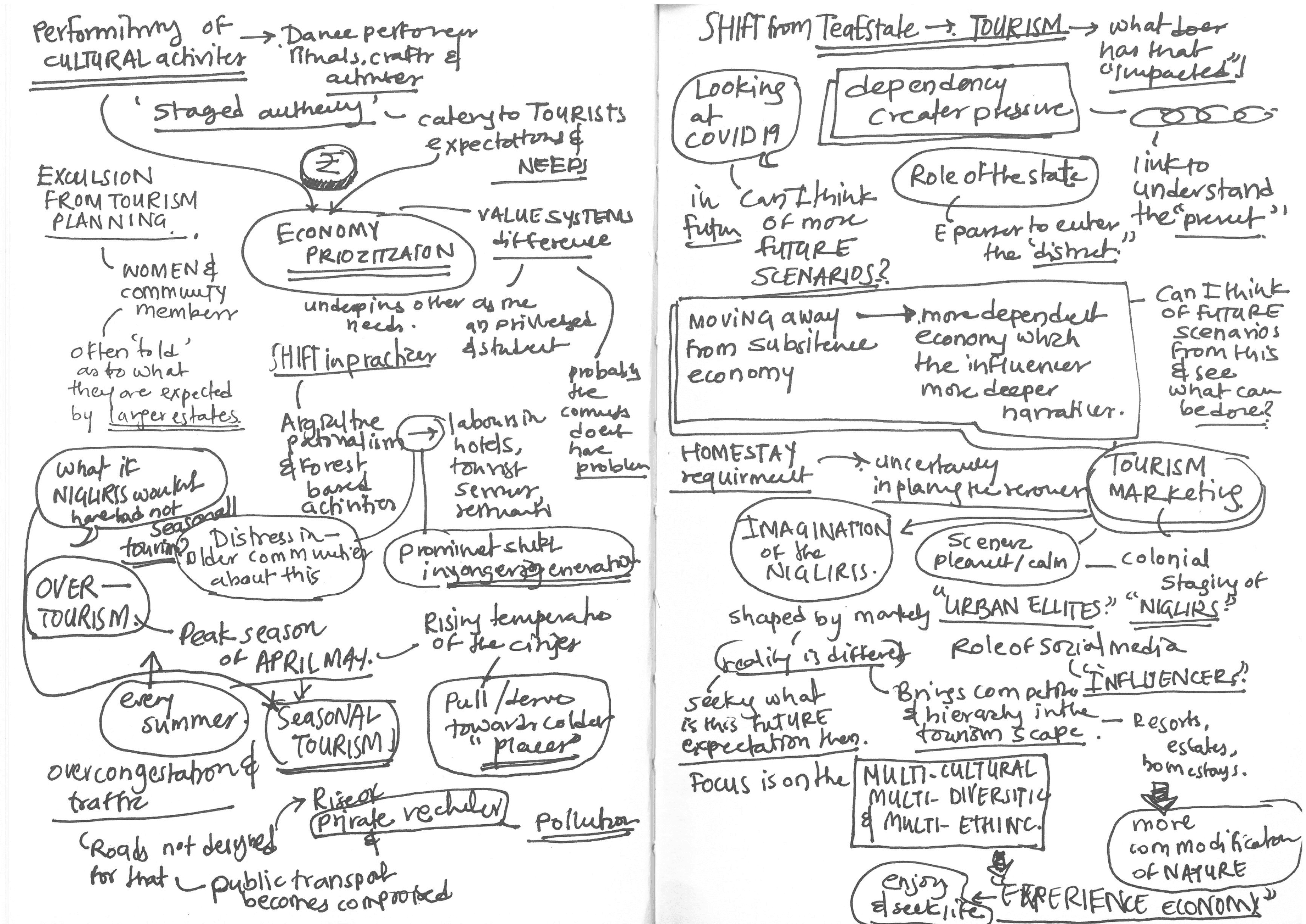
Kotagiri as the Context
Because the Nilgiris stretch across multiple settlements, tribes and ecologies, “Development” does not appear as a single, unified experience but as a set of situated stories shaped by place, history and power.
Focusing on one specific locality makes it possible to trace these dynamics with enough depth to see how policy, tourism, conservation and everyday survival intersect in people’s lives, instead of putting them into a generic hill narrative.
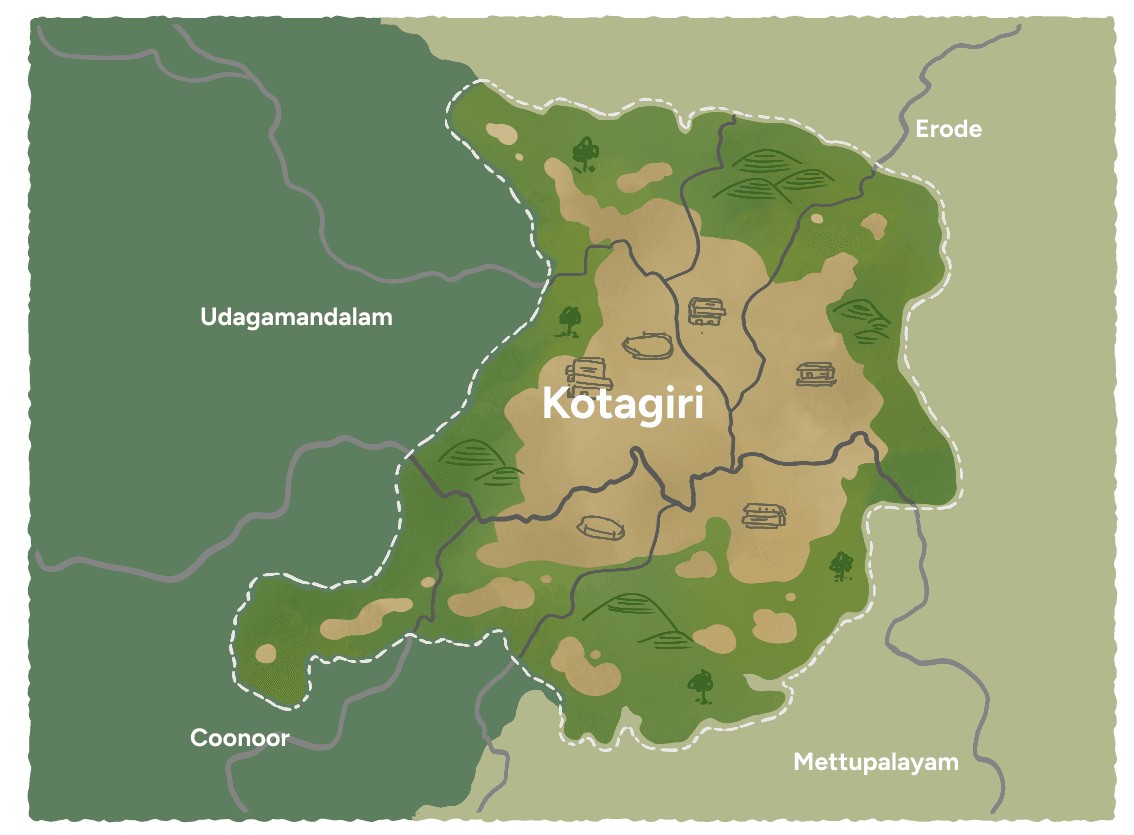
Demographic Understanding
Kotagiri taluk consists of small hill villages nested between tea estates, remnant shola forests and agricultural patches, with around 60,000–70,000 people distributed across tribal settlements, Badaga hamlets, Irula and Kurumba forest-edge communities, and migrant worker colonies.
From a development perspective, livelihoods are split between plantation labour, smallholder farming, conservation-linked work and tourism related business and social enterprise initiatives, producing highly uneven access to land, infrastructure and welfare across villages.
Ecologically, it sits on the fringe of the Nilgiri Biosphere Reserve, where fragmented forests, tea landscapes and growing waste and tourism pressures intensify human–wildlife encounters and land-use conflicts.
Findings
Mapping and synthesizing these themes into concise findings established the first layer of thematic analysis, framing subsequent primary research.

Tea Price Collapse
Smallholder estates and labour livelihoods are strained as green leaf prices drop below production costs, forcing labour cuts and selling land.

Employment Barriers
Limited non-plantation jobs lock youth and migrants into low-wage cycles, despite tourism and enterprise potential.

Service Gaps
Remote villages lack accessible healthcare and schooling, amplifying vulnerabilities amid wildlife conflicts and migration.
Discussion guide
The discussion guide was crafted to document lived realities while gently nudging participants toward futuring, envisioning what comes next. It worked equally for individual interviews and focused group discussions.

Interview Questions
Through a Structured interview pattern, I distributed the questions from individual life stories to collective concerns, grounding the inquiry in qualitative depth
Show more
Cultural Probes
Cultural probes served as futuring prompts, inviting participants to think of plausible futures from their lived realities. This anchored foresight in everyday experiences while surfacing how communities negotiate of what comes next.
Show more
Pirmary Research
Through 10 indepth interviews, 2 focused group discussions and 5 one-to-one sessions, participants were purposively sampled across three lived trajectories: Lifelong residents, Returning migrants and New-comers. Spanning ages 25–52 with a 5:3 male-to-female ratio with some participants from Todas and Badaga tribes.

Conversations shifted from amusement to what's already happening to what could happen next. When people had room to think freely, different priorities surfaced, and so did anxiety.
How do people negotiate today when tomorrow feels predetermined or out of hand? What choices get compromised?
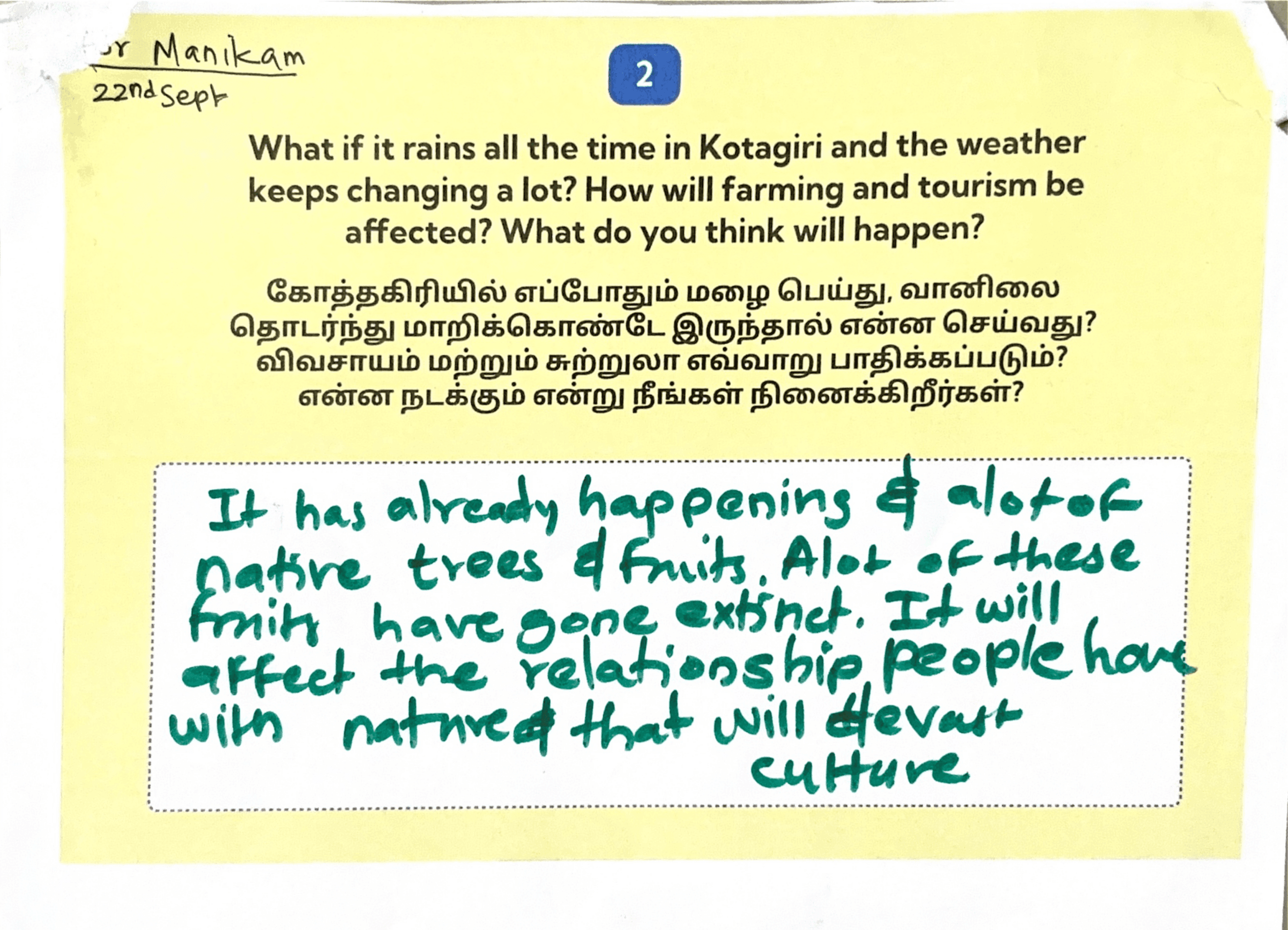
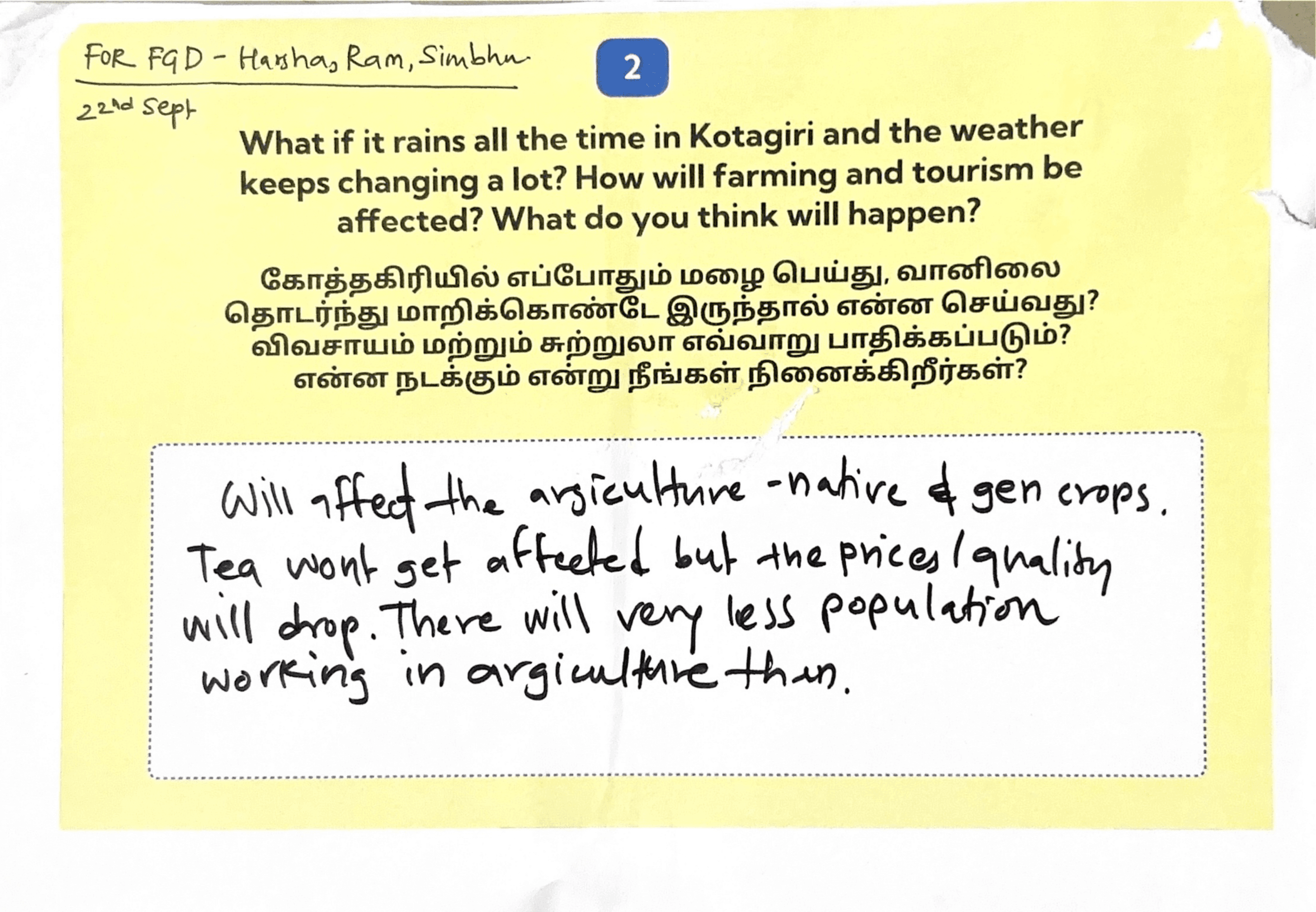
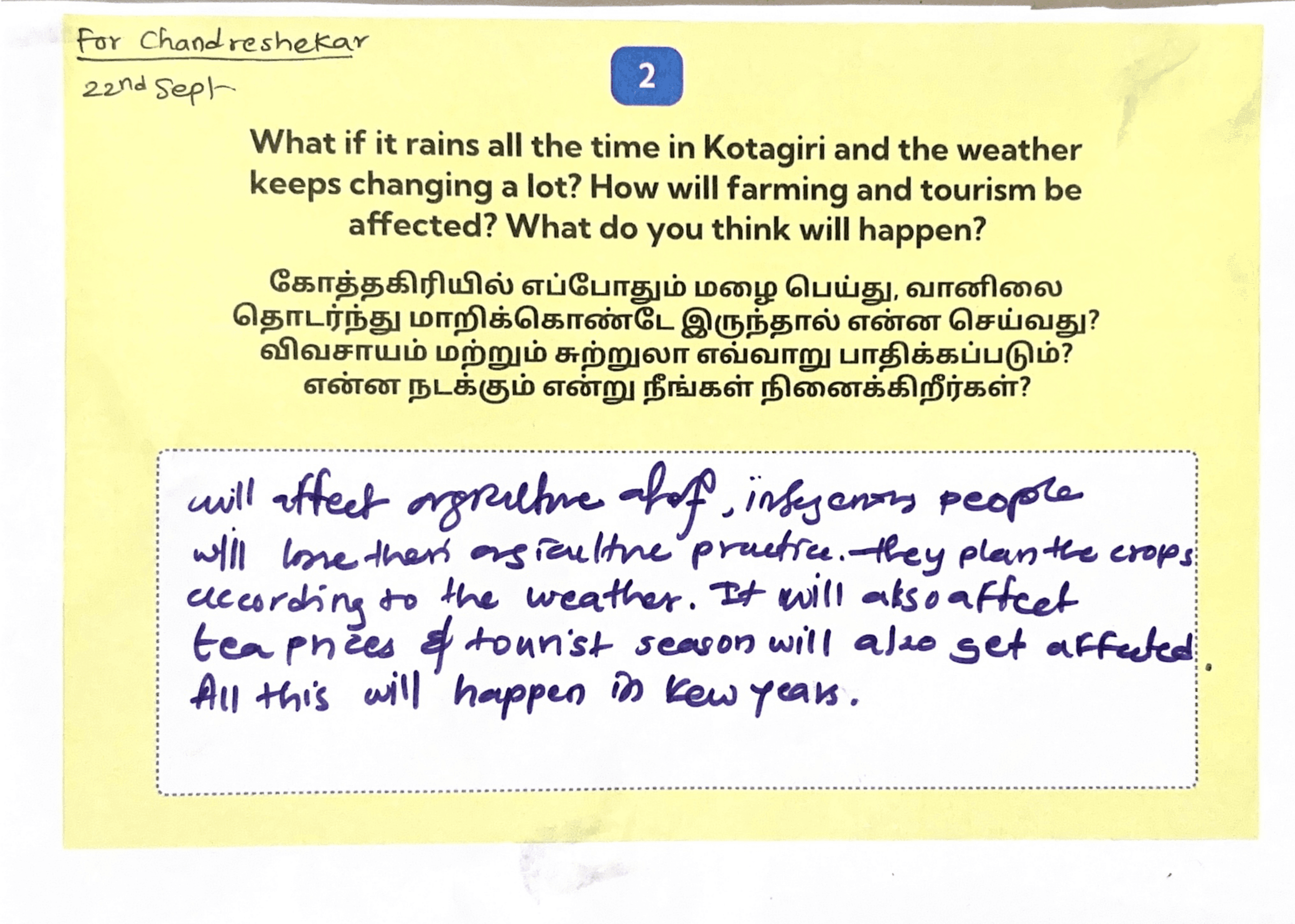
"People see green mountains, coffee, cool air. They don't see what's happening under it. No political party or government has any stakes here, its the people who have been living here and continue to live here understand and face it."
-Silambarasan I Kotagiri's Resident
Ethnographic Research
Fly-on-the-wall observation, walks through Kotagiri’s streets, chats with shopkeepers and residents became apart of ethnographic studies. Sketches and photos pinned these moments. It revealed something more deeper, traffic shortcuts, water pumps as landmarks, shared parking, those small routines reveal how developments promises bump against real limits, forcing people to improvise around the cracks
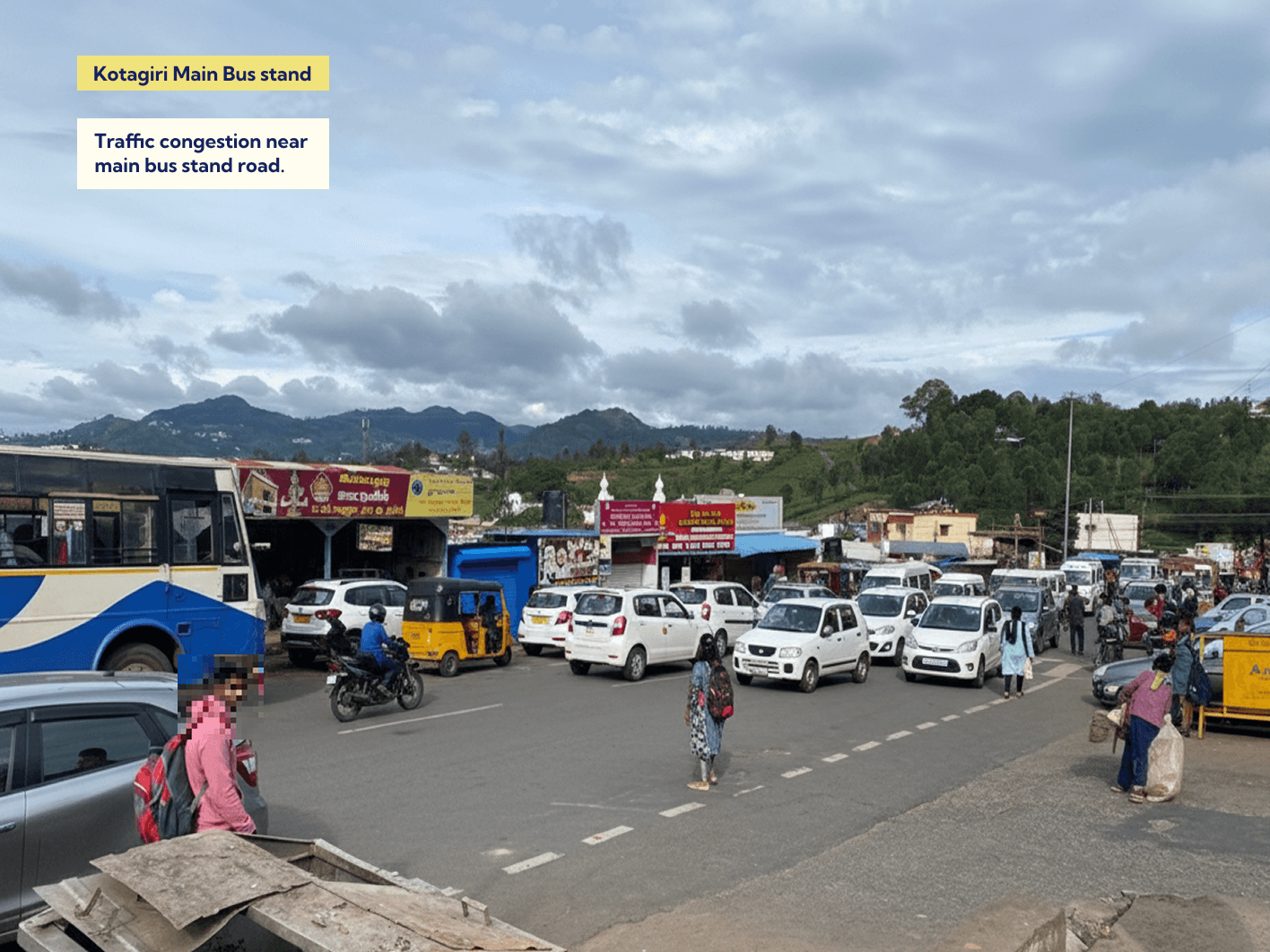
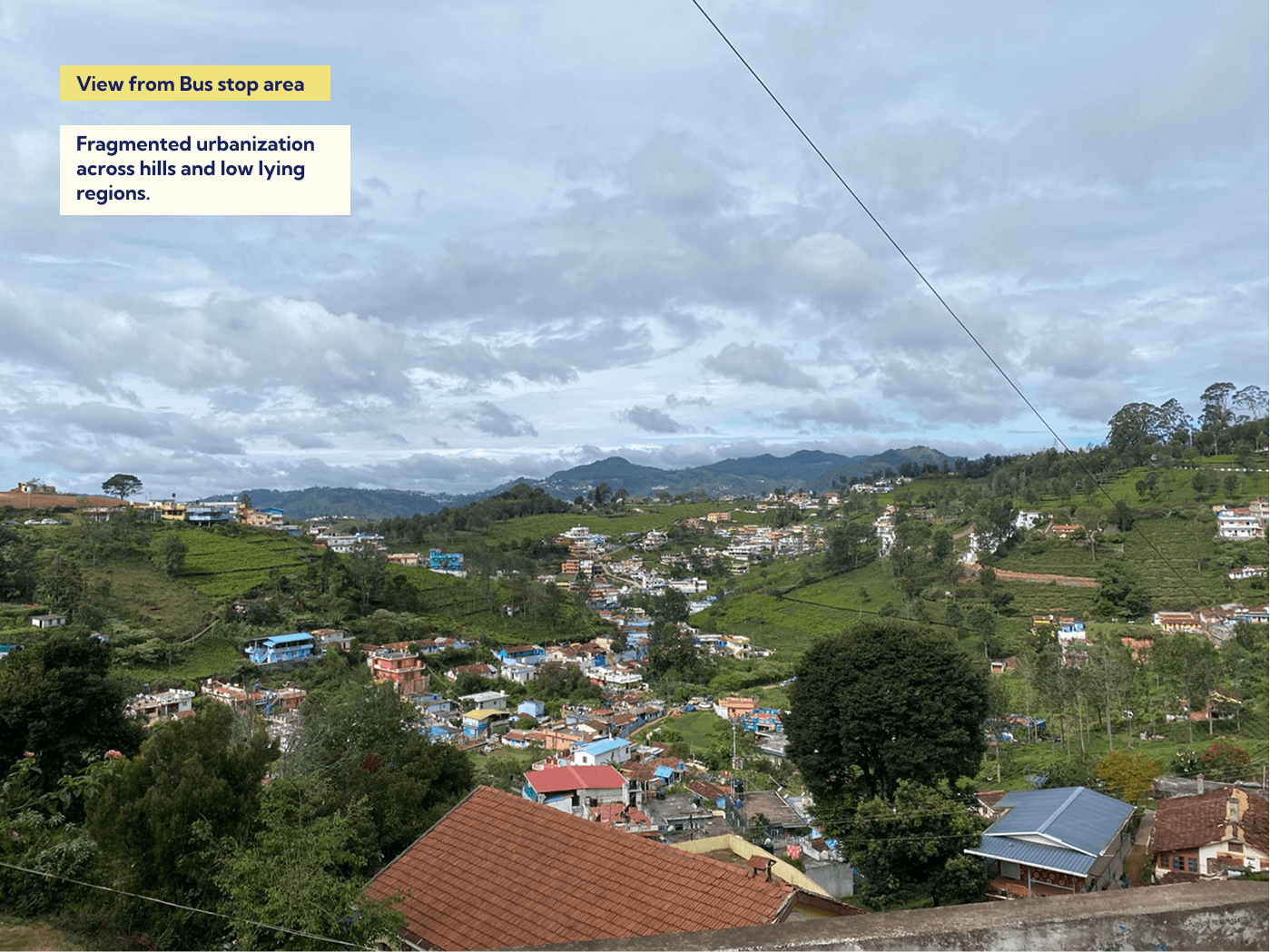
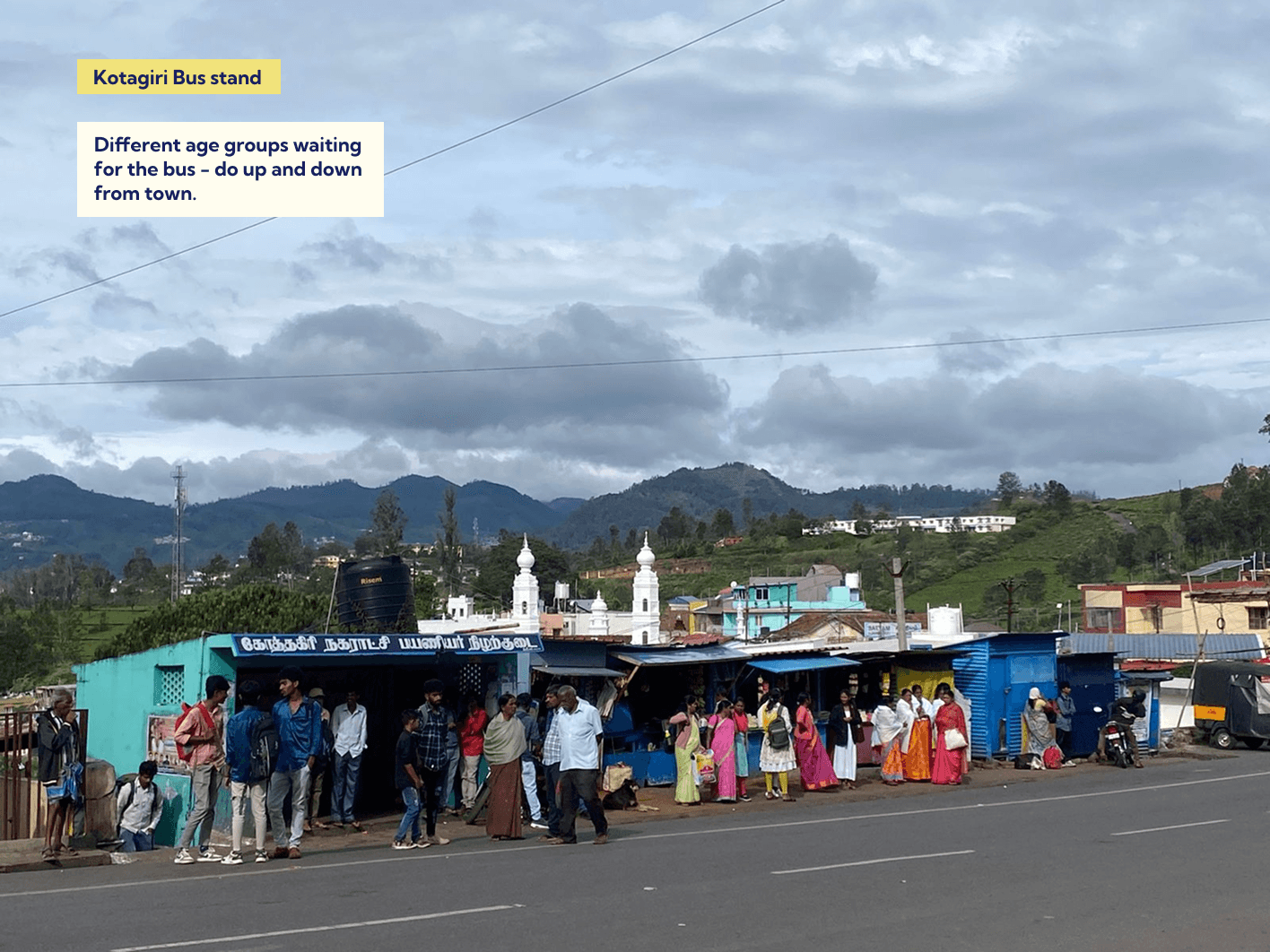
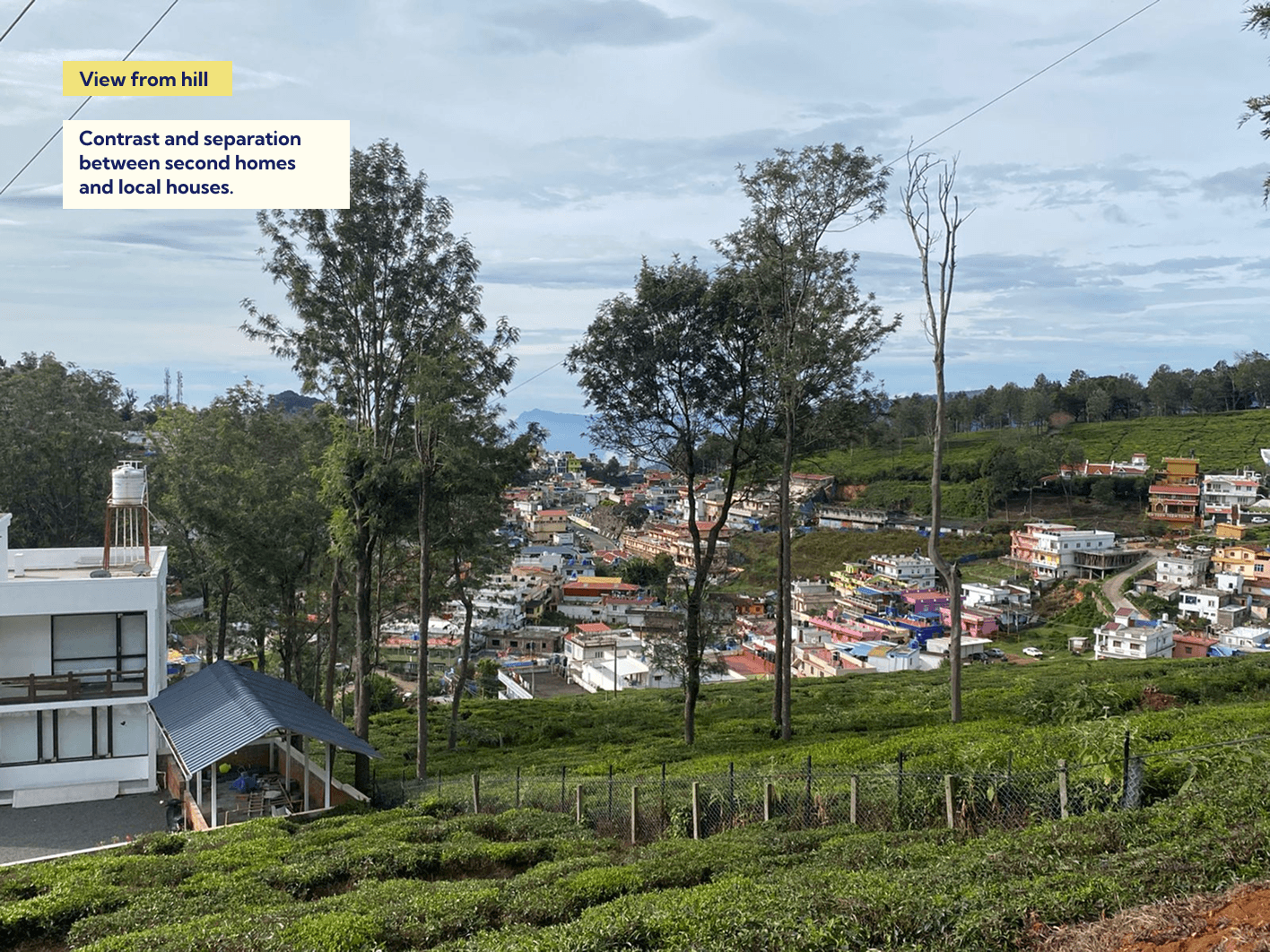
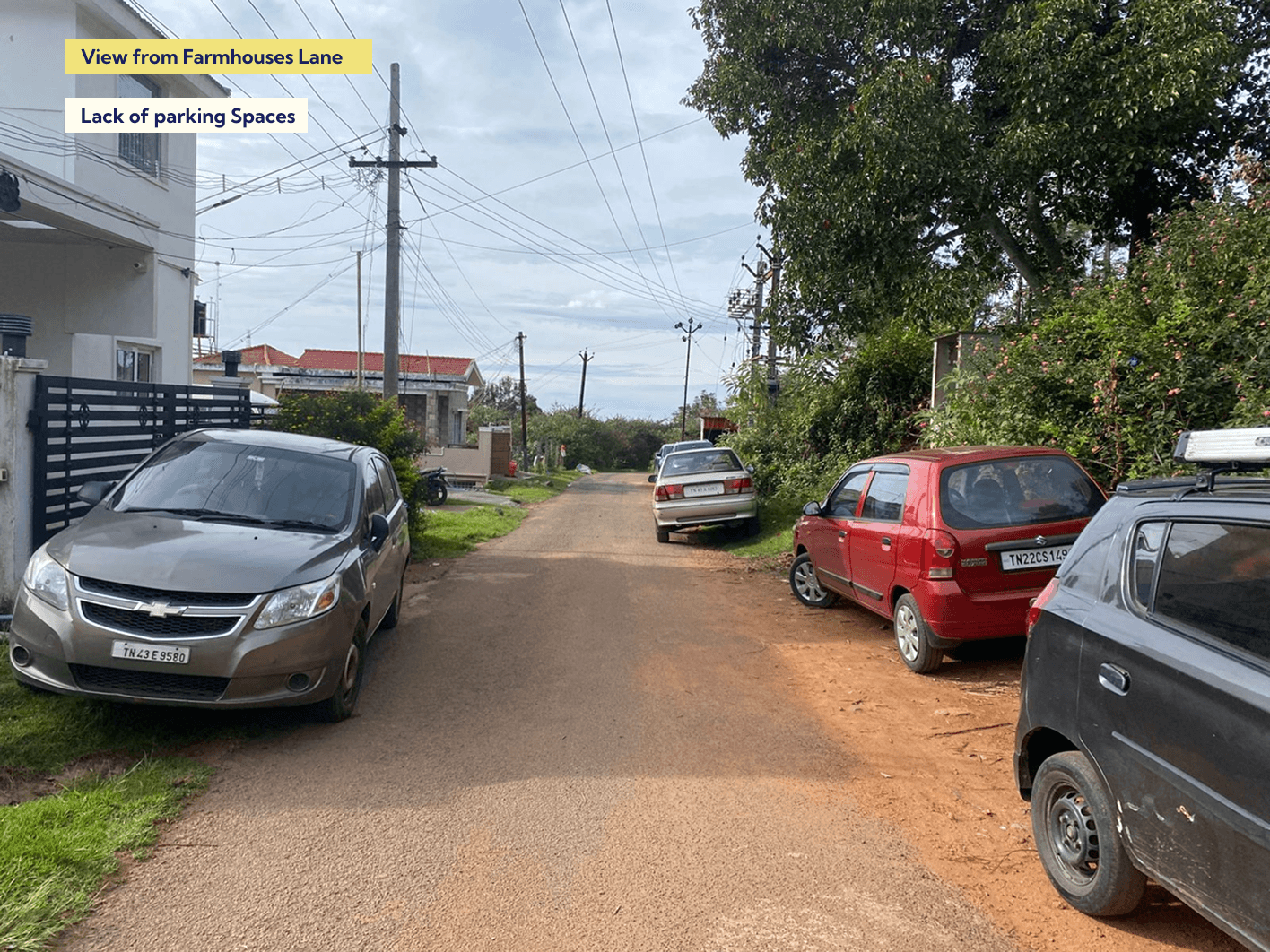
By mapping out the impacts and changes, I understood how deeply the system of deprivation is interconnected.
The picture wasn't isolated problems but an interlocked system where one consequence becomes a catalyst for another.
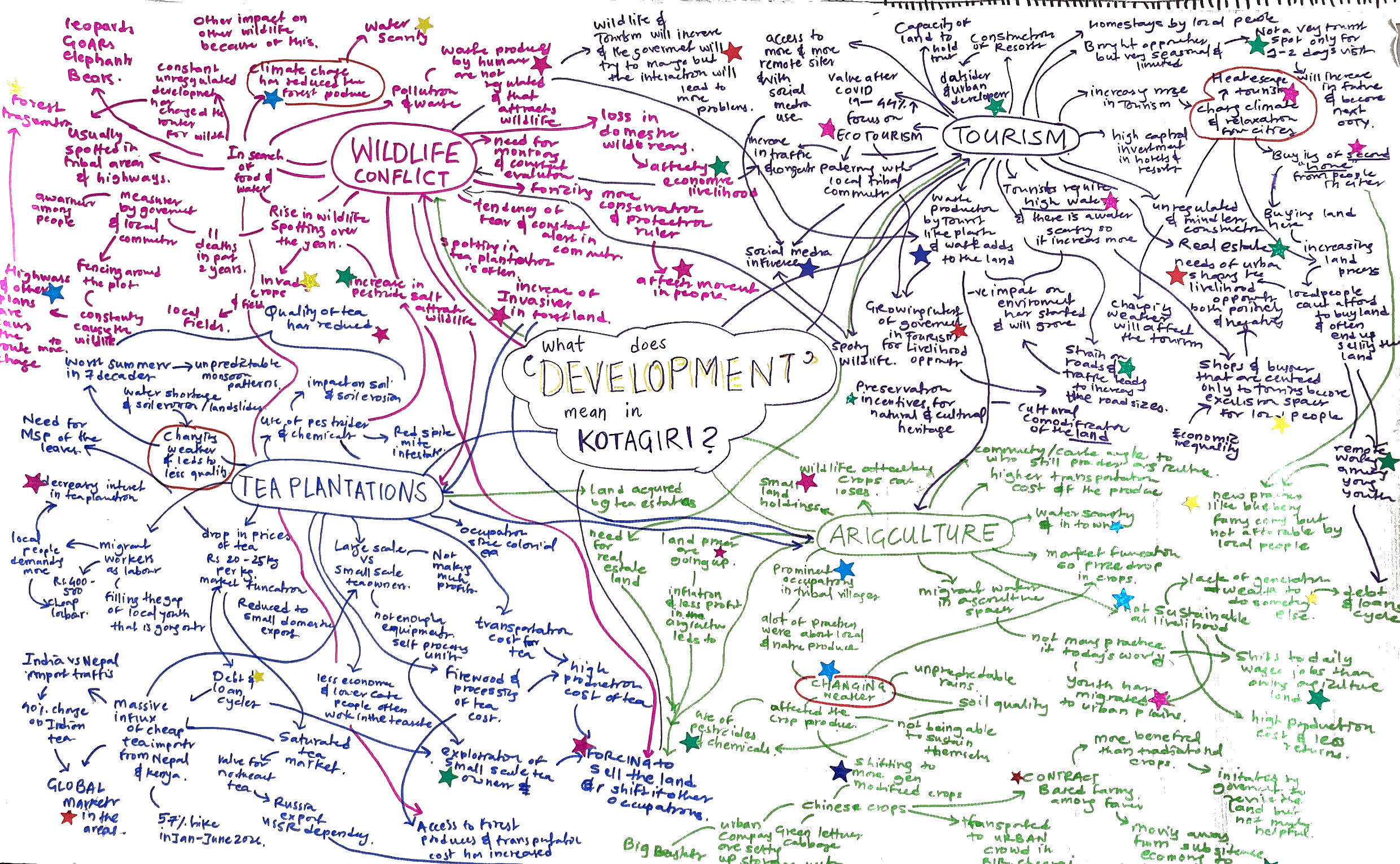

With a limited data sample, how can I expand the research to uncover deeper narratives and concerns? What studies can I use to supplement and expand on my primary research?
Accessing other Research bodies
Keystone Foundation, a conservation and community wellbeing organisation in Kotagiri, conducted a research project called "NIligirs 2050" under which Shawn Stephen and Merab Varghese facilitated two workshops with 30 youth members of kotagiri(Age 18–35) to surface lived concerns and collectively discuss solutions.
The first session mapped problems across four thematic buckets: Basic needs, Culture and Collective identity, Inequality and Redistribution, and Governance.
"Young people rarely have the space to gather and think collectively about futures in the Nilgiris.The participants expressed a deep interest in exploring these conversations further."
-Shawn Stephen I Workshop Facilitator
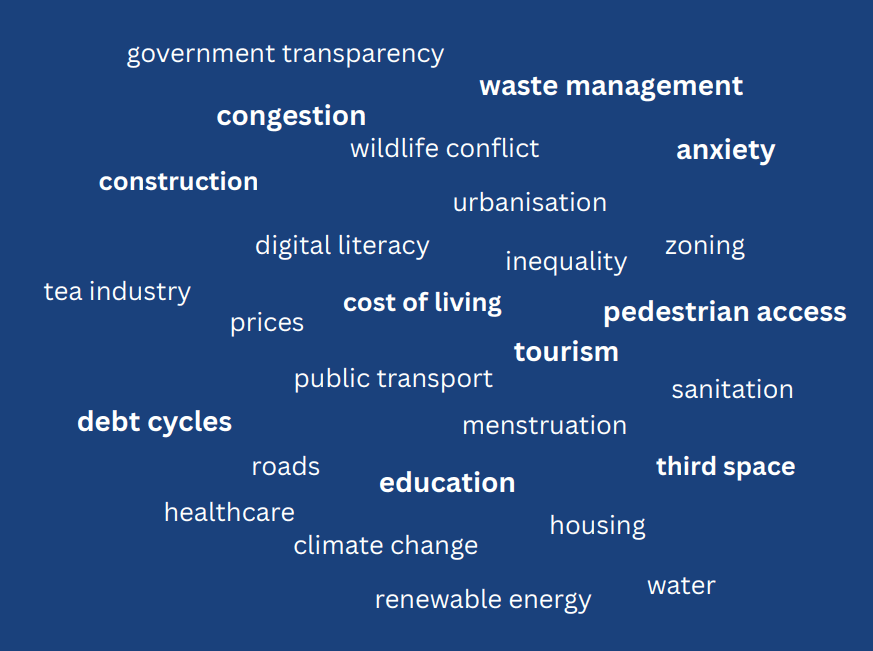
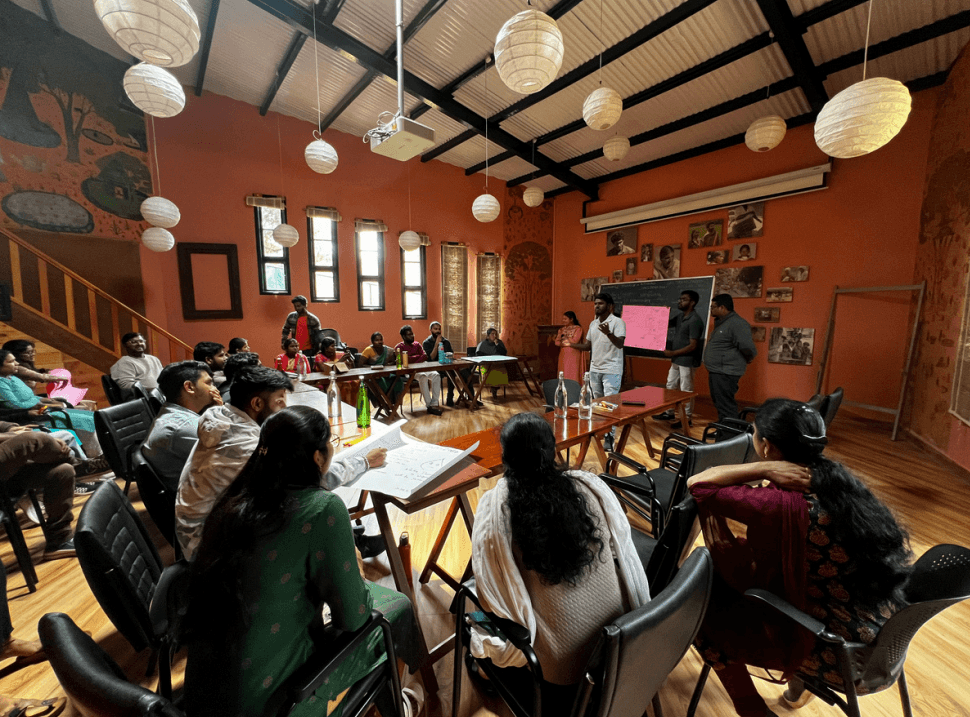
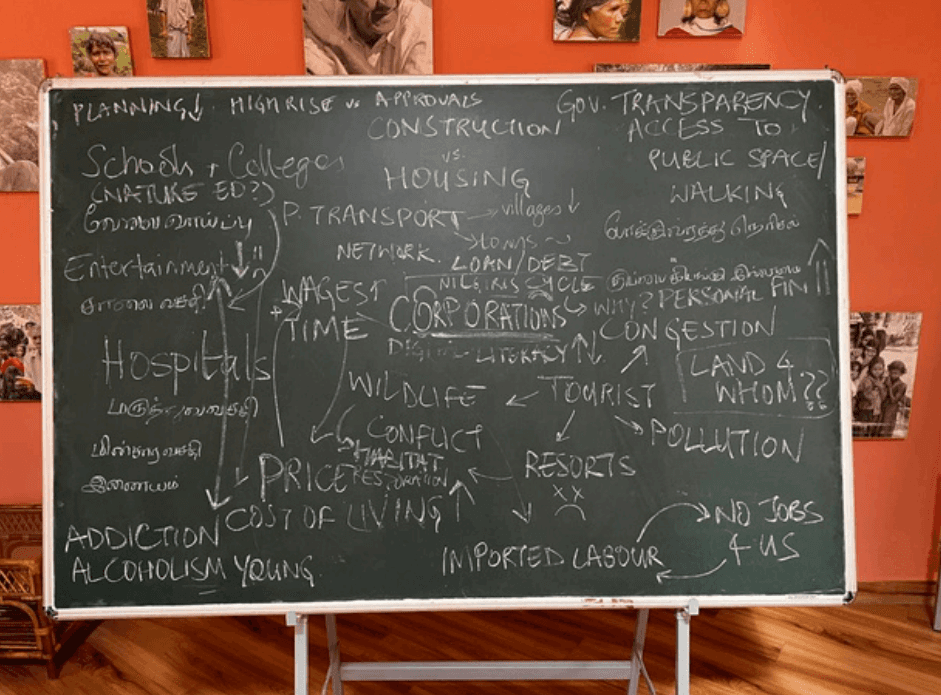
Insights
Through research, 3 core insights were crafted about how youth in Kotagiri navigate choices and imagine futures, what shapes their decisions, what holds them back, what they're grappling with.

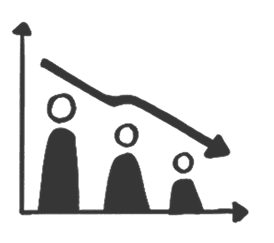
Agency That Doesn't Scale
Youth exercise personal choices in education, employment, and finances, yet these funnel into predetermined outcomes shaped by uncontrollable systems. Infrastructure, climate shifts, and market forces override individual agency, where the ability to "choose" feels limited and the larger systems have created predetermined outcomes.
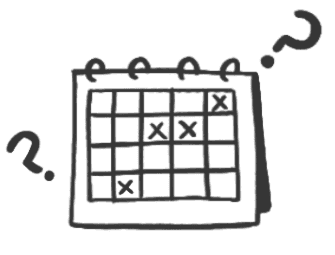
Planning in Uncertainty
Rapid, compounding shifts in climate patterns, tourism flows, wildlife pressure, and market structures create genuine unpredictability. Youth see these changes as inevitable rather than negotiable. Under rational Behaviour, planning beyond 5 years feels risky.
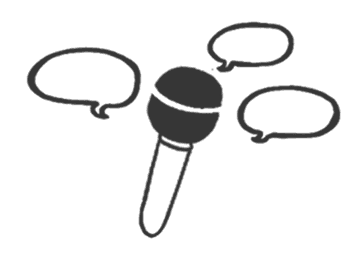
Lack of Meaningful discussions
Communities have clear understanding of their needs, sustainable livelihoods, water access, participation in land-use decisions. Interviews reveal articulate, specific visions. Lack of meaningful spaces to collectively discuss and negotiate becomes a barrier.
How might we?
"How might we build dialogue space where youth move from passive respondents to active agents, discussing present's tensions,
co-creating tomorrow's systems, and building resilience?"
We know this is not ideal but the mobile version of this project is WIP!
You can view the project on desktop!
We know this is not ideal but the mobile version of this project is WIP!
You can view the project on desktop!
Learning Objectives
From these insights emerged a set of design opportunities, spaces and conversations through which youth could reclaim agency within their own ecosystem.

Understand cause and effect across ecosystems

Pause, Observe, and Critique present systems
Evaluate and negotiate with development initiatives
Actively imagine and articulate hopeful futures
Develop a Vocabulary of accountability and reflection.
Strategize over building resilient, adaptable systems
Learning about Speculative Design
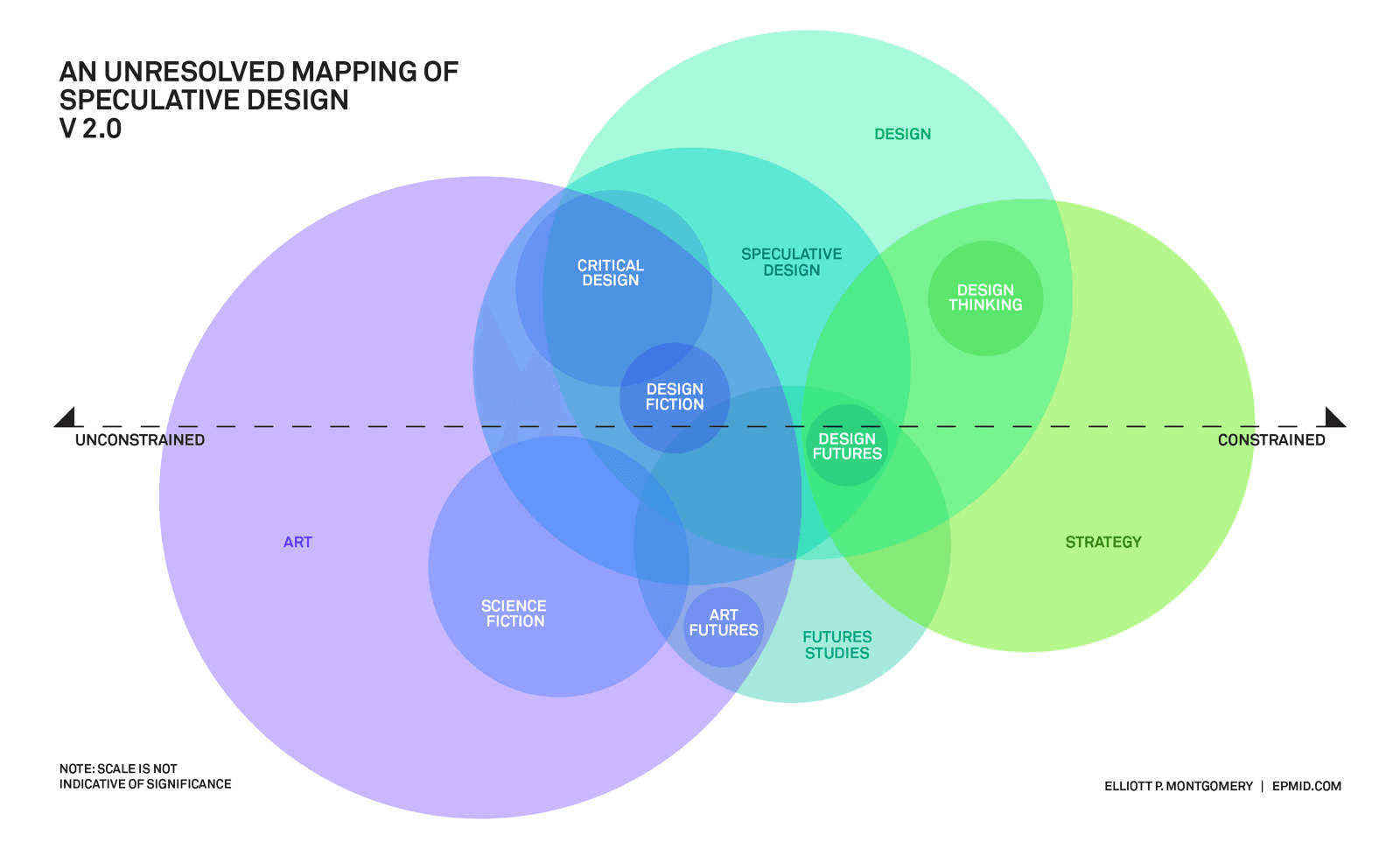
Map of Design Futures by Elliot P Montgomery
"By equipping people with confidence in their visions and a sense of agency, we do not ignore the considerable challenges facing the lifeforms on this planet, but we equip them with a vocabulary of hopeful tools on that relation."
-Anne Lighte I Community Futures Thinker

Counterfactual Methods for Community-Led Futures
A framework for collective imagination that moves beyond top-down future scenarios. It centers counterfactual thinking, exploring different imagined pasts to shape preferable futures, enabling communities to own and appropriate speculative outcomes.
Speculation Catalyzing Systemic Shifts
When community futures imagination is embedded within iterative policy and institutional processes, it catalyzes measurable shifts in perception, agency, and systemic behavior, moving speculation from ideation toward concrete institutional change.
HUM 2035
A design fiction by Quicksand Studios exploring how local humanitarian ecosystems in India might operate independently from Global North funding and infrastructure dependencies in 2035.
Democratizing Mundane Speculation
Extrapolation Factory's participatory design fiction that invites non-experts to imagine everyday products of the future, then installs them unexpectedly in actual dollar stores to provoke public conversation.
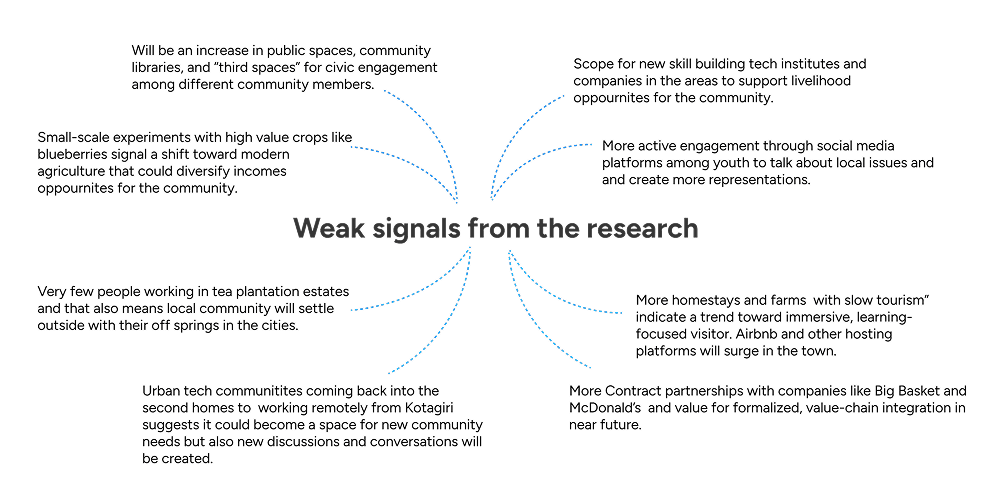
Weak signals
Weak signals are early hints of future trends that are starting to show up but are not fully formed yet, like using AI in everyday cooking and utilities. By tracing these weak signals in Kotagiri, it becomes possible to imagine and build plausible future realities for the town.
Community led Foresight Design
Using futurist Stuart Candy’s framework, futuring is approached through three key lenses: participatory, experiential, and place-based. This way of working grounds foresight in lived experience, shared imagination, and specific contexts, making future scenarios more tangible and relevant.
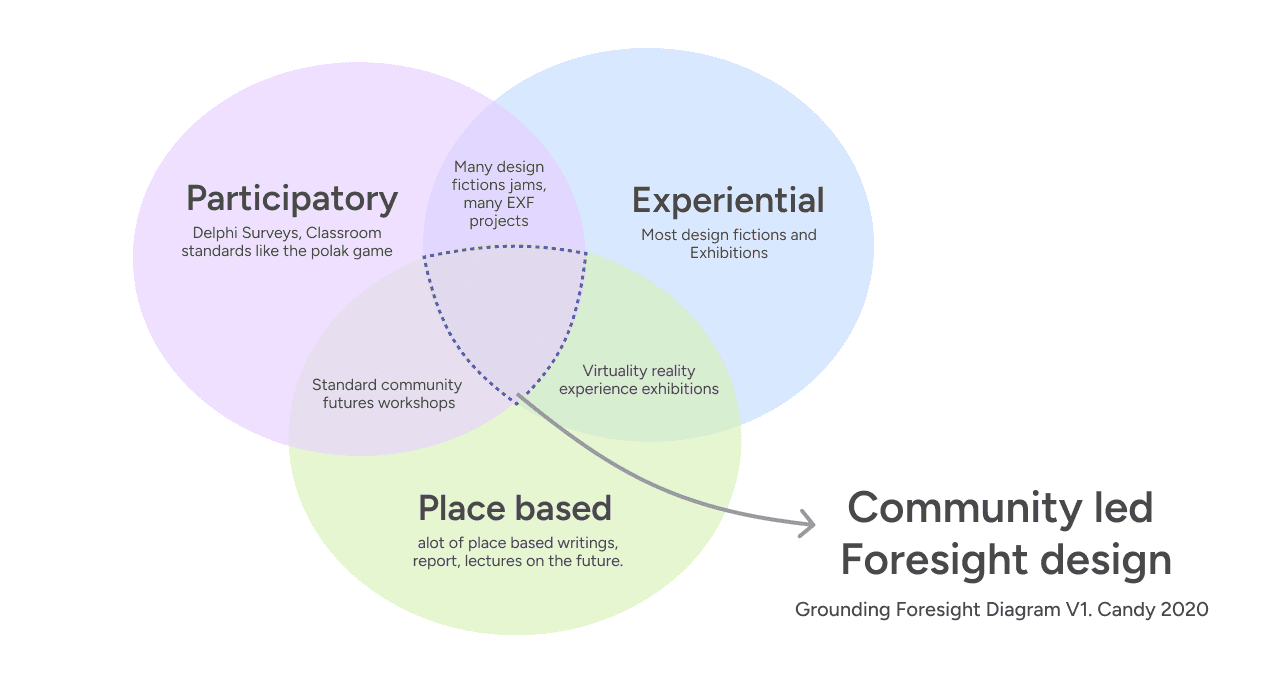
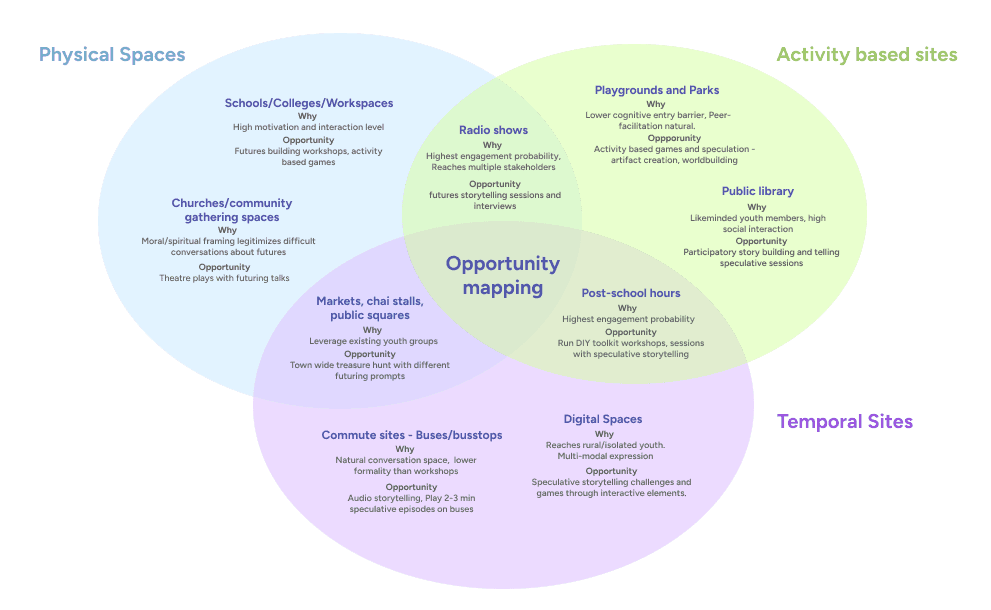
Oppournity Mapping
Ideation of the Workshop

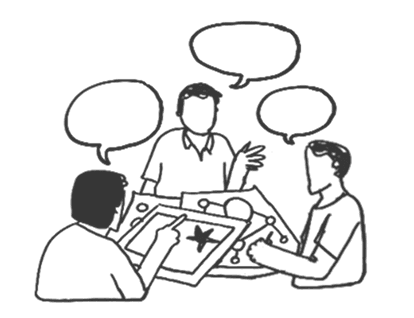
TIme travel Workshop
Youth first map Kotagiri as it exists today and think about the consequences, then time-travel through storytelling to imagine it ten years ahead. In this future landscape, they ask: if they had agency, what would they want? What can they do reach that future?
Pro's and Con's
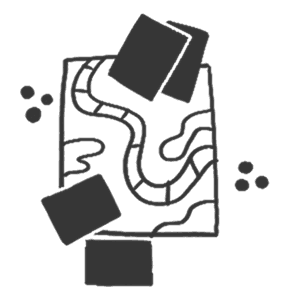
Development Negotiation Game
A strategy game exploring tensions between tourism, livelihood, resources. Cards represent upcoming development plans and timeframes. By embodying different stakeholders, youth has to evaluate and negotiate development plans collaboratively using different resources.
Pro's and Con's
Futures Making Kit
A creative toolkit with prompts, materials, and templates guiding youth to examine the present critically. Speculative prompts "What if you had to redesign how Kotagiri uses water, what's your first move?" provoke imagination about futures they can shape and can be evidences of alternatives.
Pro's and Con's

Community Futures Radio
Youth run a social club where they interview community elders, farmers, and women, recording their visions of Kotagiri's future. Stories edited into speculative episodes blending present reality with imagined futures. This becomes a medium of accountability for places in power.
Pro's and Con's
Combination of ideas
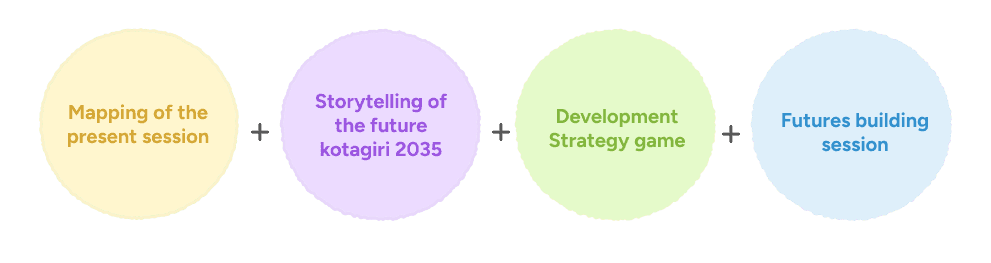
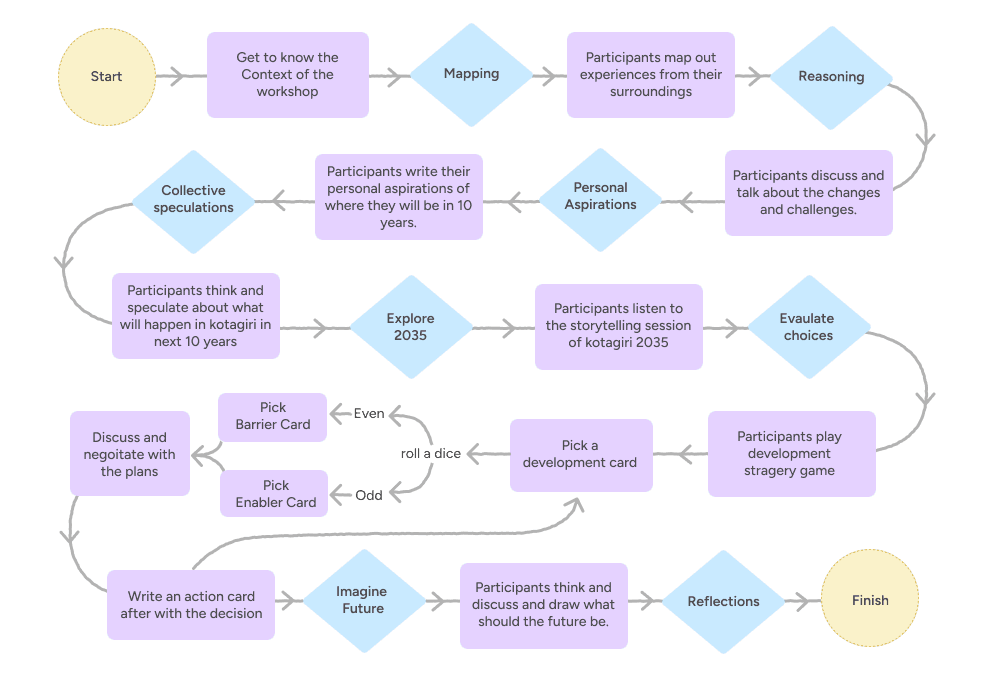
Intended as a participatory learning experience, this workshop design combines embodied storytelling, cards, and reflection prompts. Core theme: provoke plural futures rather than consensus. Facilitation will guide youth to observe challenges, evaluate plans and imagine divergent visions of Kotagiri 2035.
Iteration and Testing of the Game/workshop
Iteration 1
Iteration 2

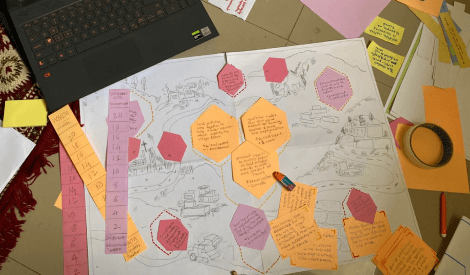
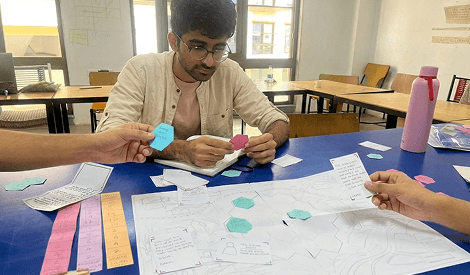
Kotagiri's landscape becomes the game board. Development tiles represent incoming changes. Youth use resources to negotiate impacts, resolve conflicts, and imagine futures together. They can edit existing plans or propose new ones, thereby transforming speculation from commentary into collaborative design using play.
Whats Working?


Open tiles sparked unexpected combinations and imaginations.
Visual resource tracking made abstract trade-offs immediately visible.
Action cards created barrier and elements, building the curiosity.
Whats not Working?

Action cards oversimplified complex resource realities.
Real consequences of development choices were abstracted away.
Fatigue set in after 2-3 rounds, attention dropped significantly.
Experience Mapping
Developing the collaterals
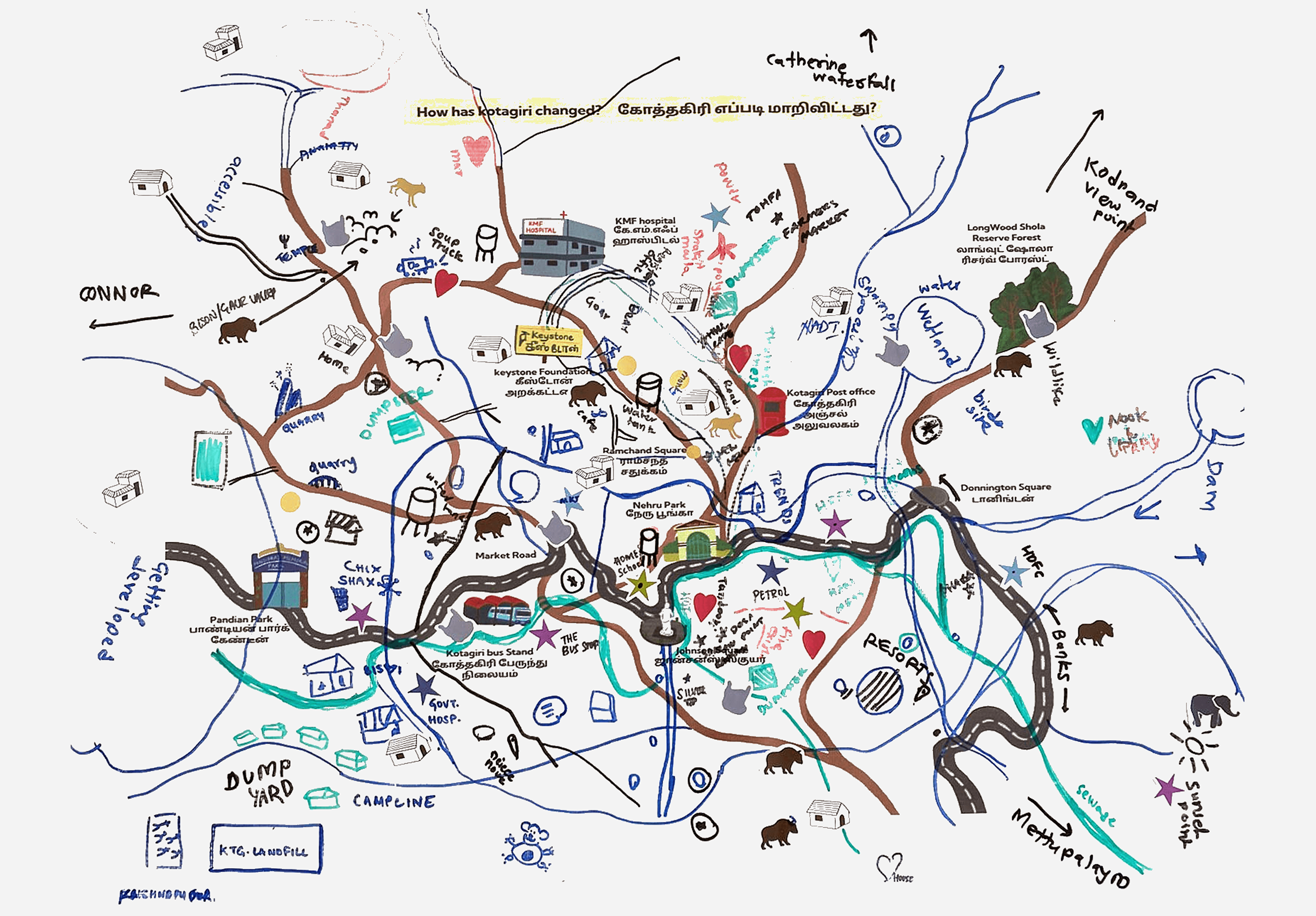
Map of the Present
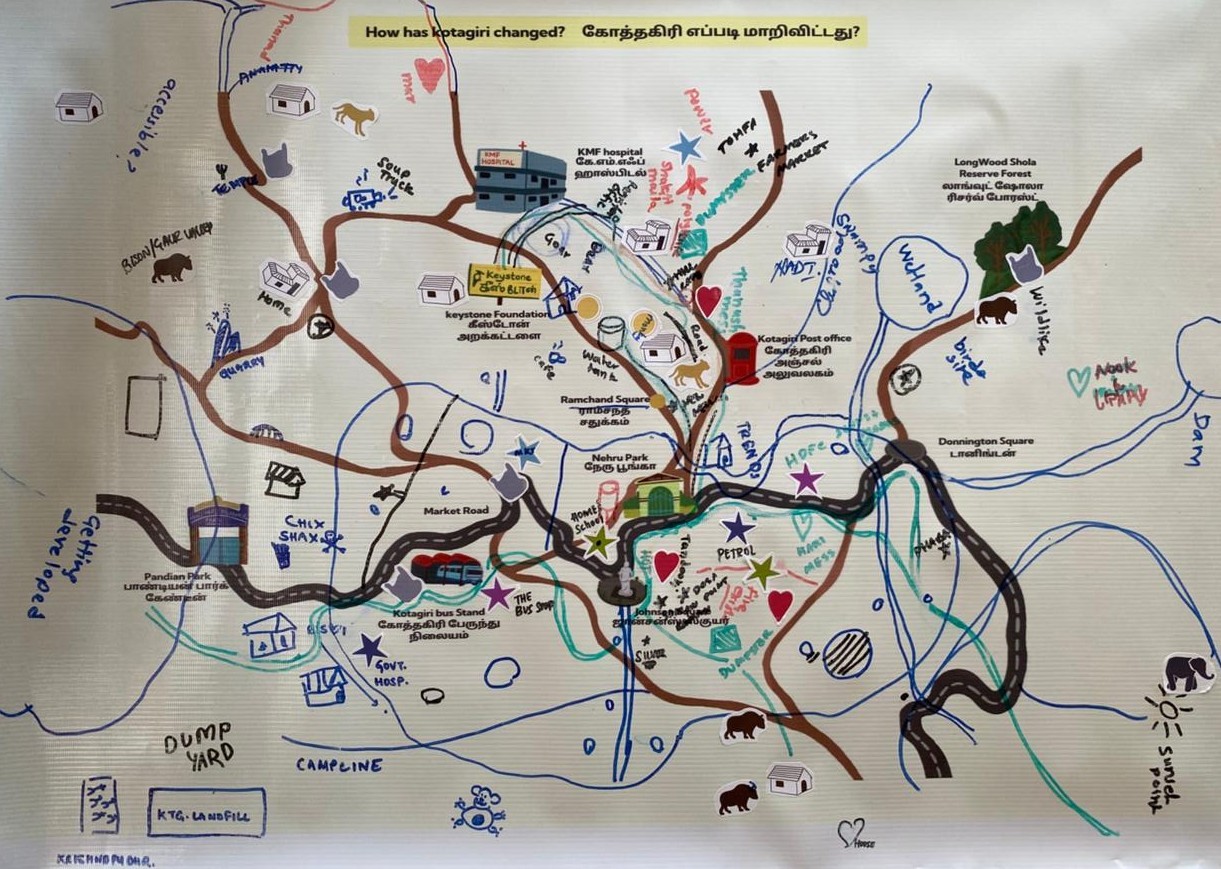
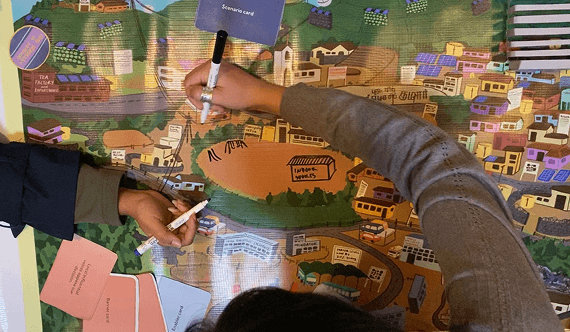
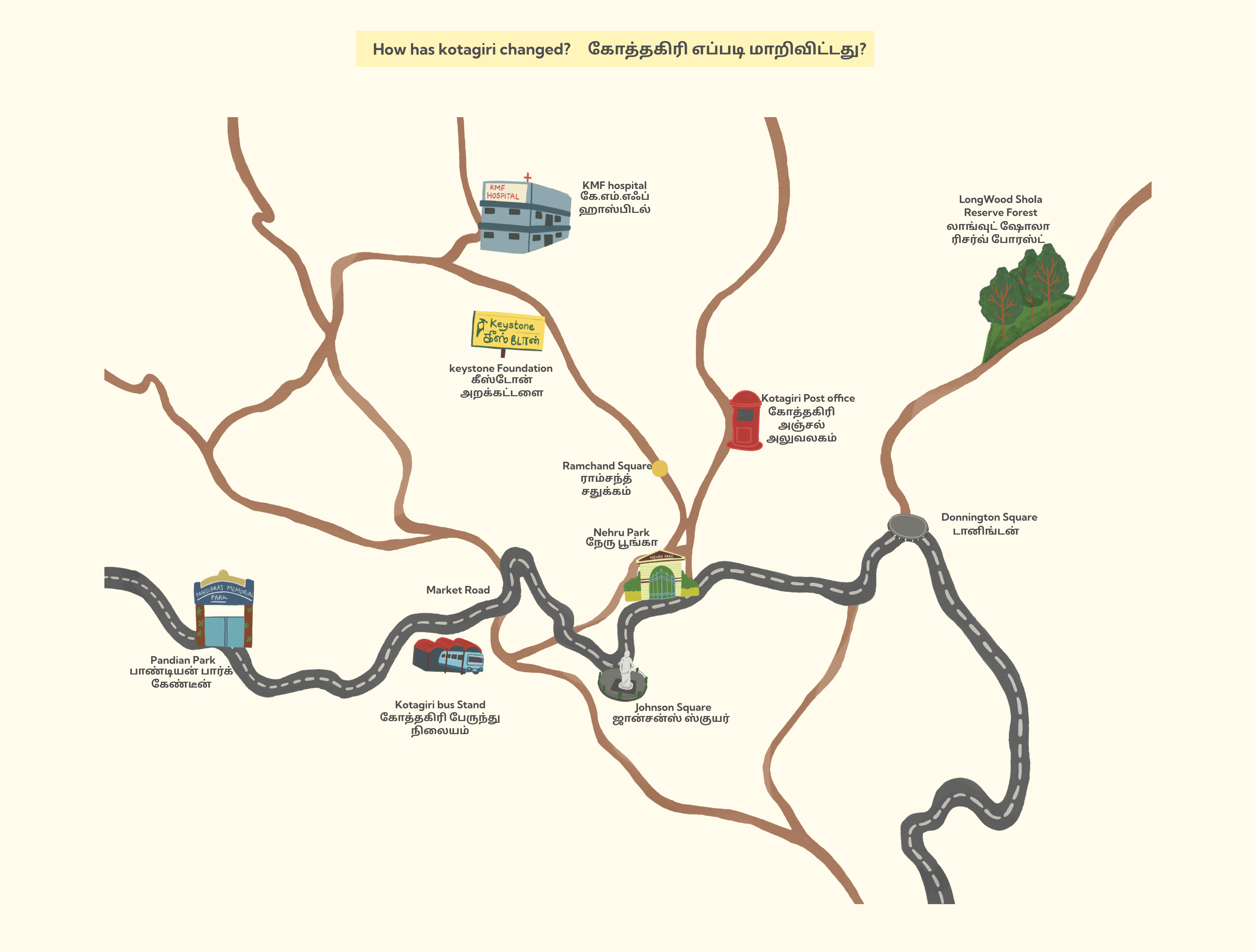
Using a 5x6 feet map of Kotagiri's landmarks and roads, youth mark everyday places, actions, and problems with stickers and markers. Rather than passive mapping, dialogue emerges: Why does this space matter? What happens here? What should change? The map becomes a collective articulation of present realities.
Prompts for Discussion
The prompts moved from Personal everyday actions to larger issues building a sense of connection on everyday life. Like On this big map, where is your home? What are the common routes you take? What changes have you noticed there in 1 year? What are the 2 spots in the town that you often go to?
Kotagiri 2035
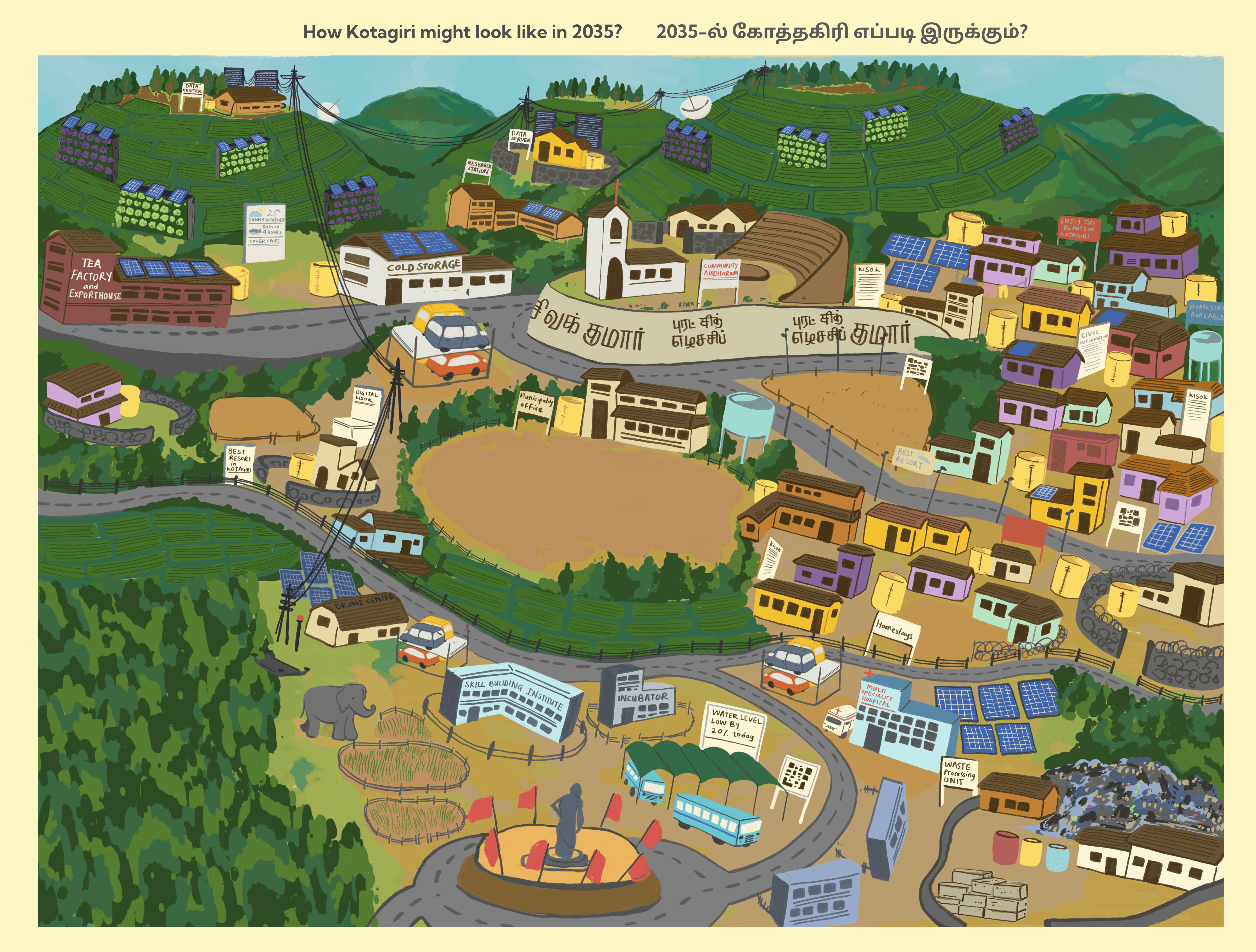
Participants time-travel into Kotagiri 2035 through embodied storytelling, encountering a world where community agency and accountability coexist. They navigate complex scenarios rooted in present weak signals. Rather than linear progress, the world reveals interdependencies and trade-offs. Core intent: worldbuild futures emerging from uncertainty toward agency. The map holds tension: hopeful yet accountable, complex yet honest.
In this first iteration, the future map was researcher-constructed, drawing on the Nilgiris 2050 report by Keystone foundation. Rather than claim neutrality, the design acknowledges this limitation. Over iterations, youth workshops will reshape this map, replacing my researchers perspective with plural futures imagined collectively.

1
2
2
3
5
4
7
13
9
11
10
14
15
8
6
12
Development Cards
Following the 2035 immersion, participants transition into a development strategy game grounded in present reality. Three incoming development plans face the municipality. Participants evaluate and negotiate impacts and benefits, surfacing priorities and trade-offs. The game shifts from imagining futures to engaging with real governance: What should Kotagiri accept? What should be contested?

Barrier, Enabler cards
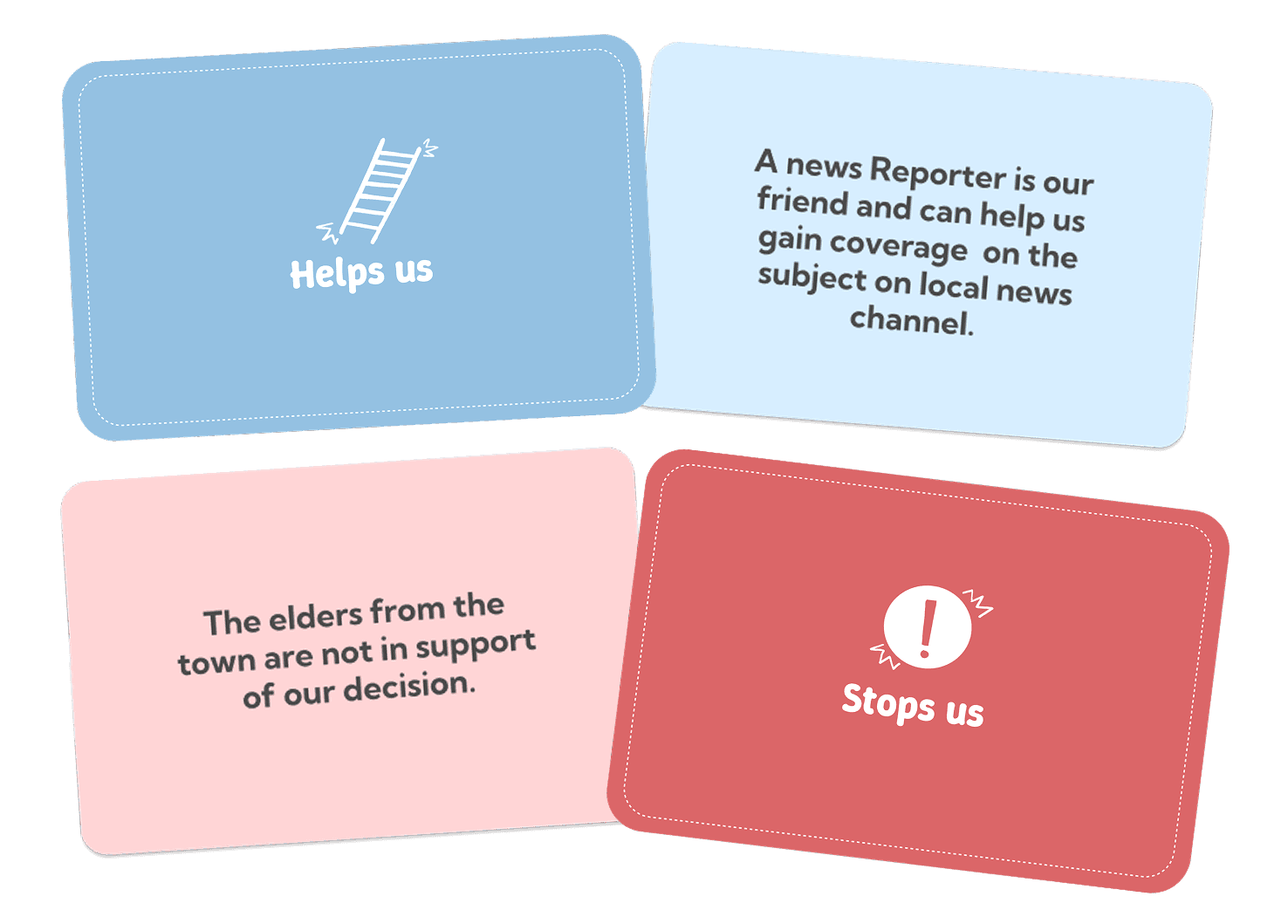
To provoke divergent approaches to development plans, barrier and enabler cards introduce uncertainty into negotiations.
A dice roll determines encounter: odd numbers surface barriers (constraints, conflicts, resource scarcity); even numbers reveal enablers (opportunities, alliances, innovations).
This mechanics tried to mirror reality as decisions don't unfold in controlled conditions. Unknown factors interrupt plans leading to adaptations.
Worshops
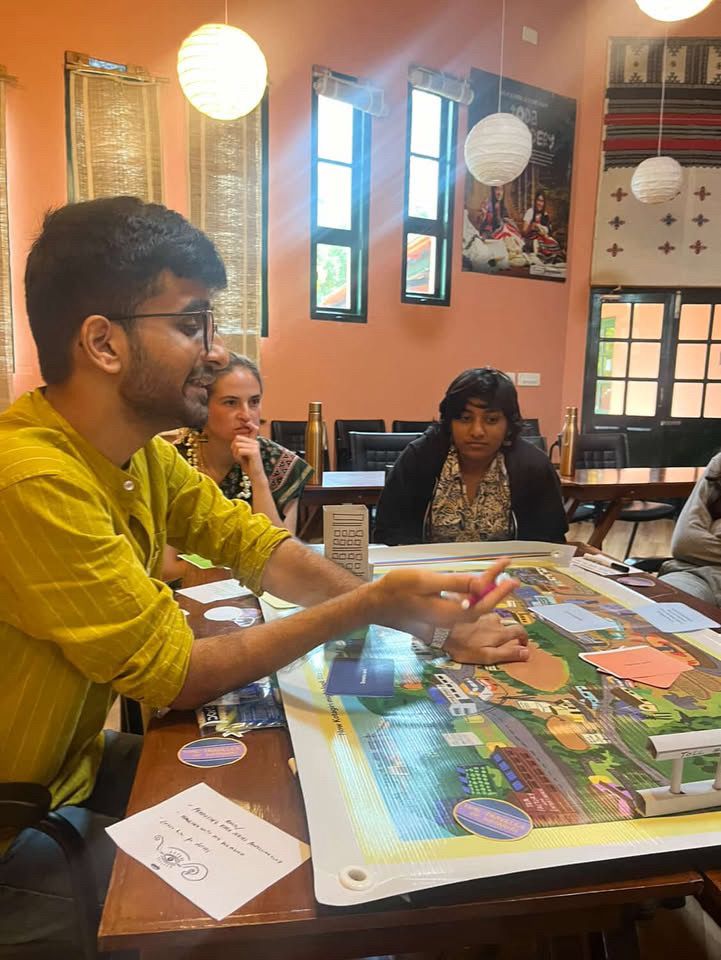
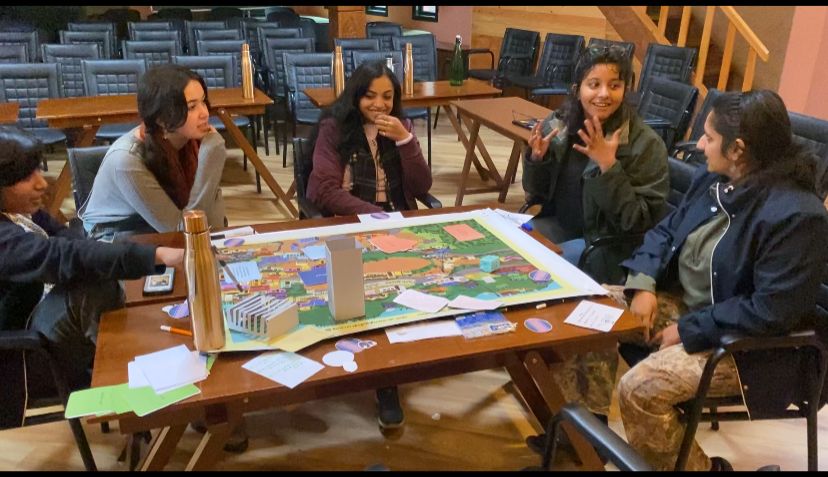
Over five workshops ran in Kotagiri in November 2025, held at Keystone campus, Book Cafe Book Club, the church. Each spot brought different people, different lives. Diversity shaped the conversations from the start. With a time and logistical constrain, a less data sample of workshop was tested but it created a good starting point to iterate for future sessions.
5
Workshops
15
Participants
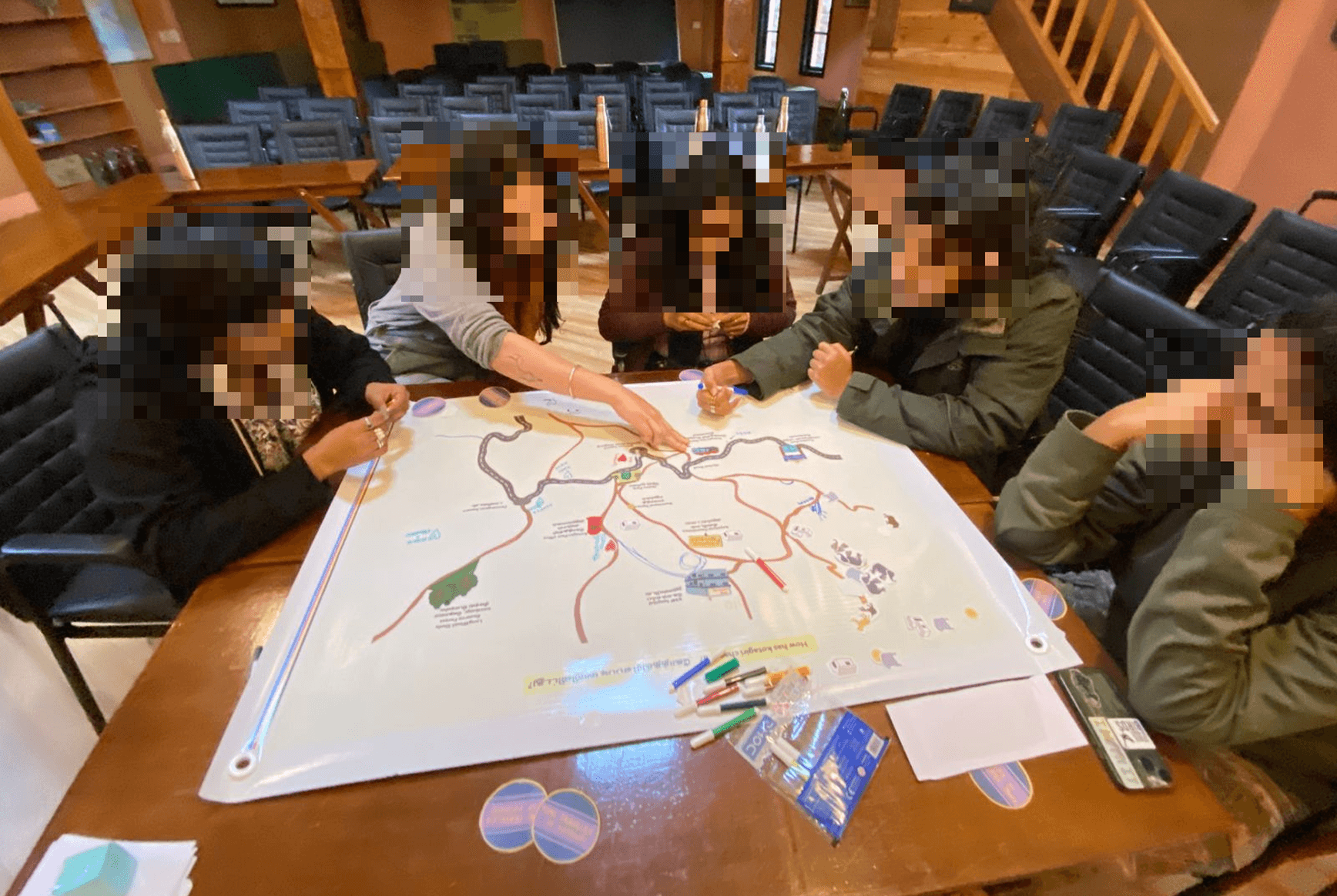
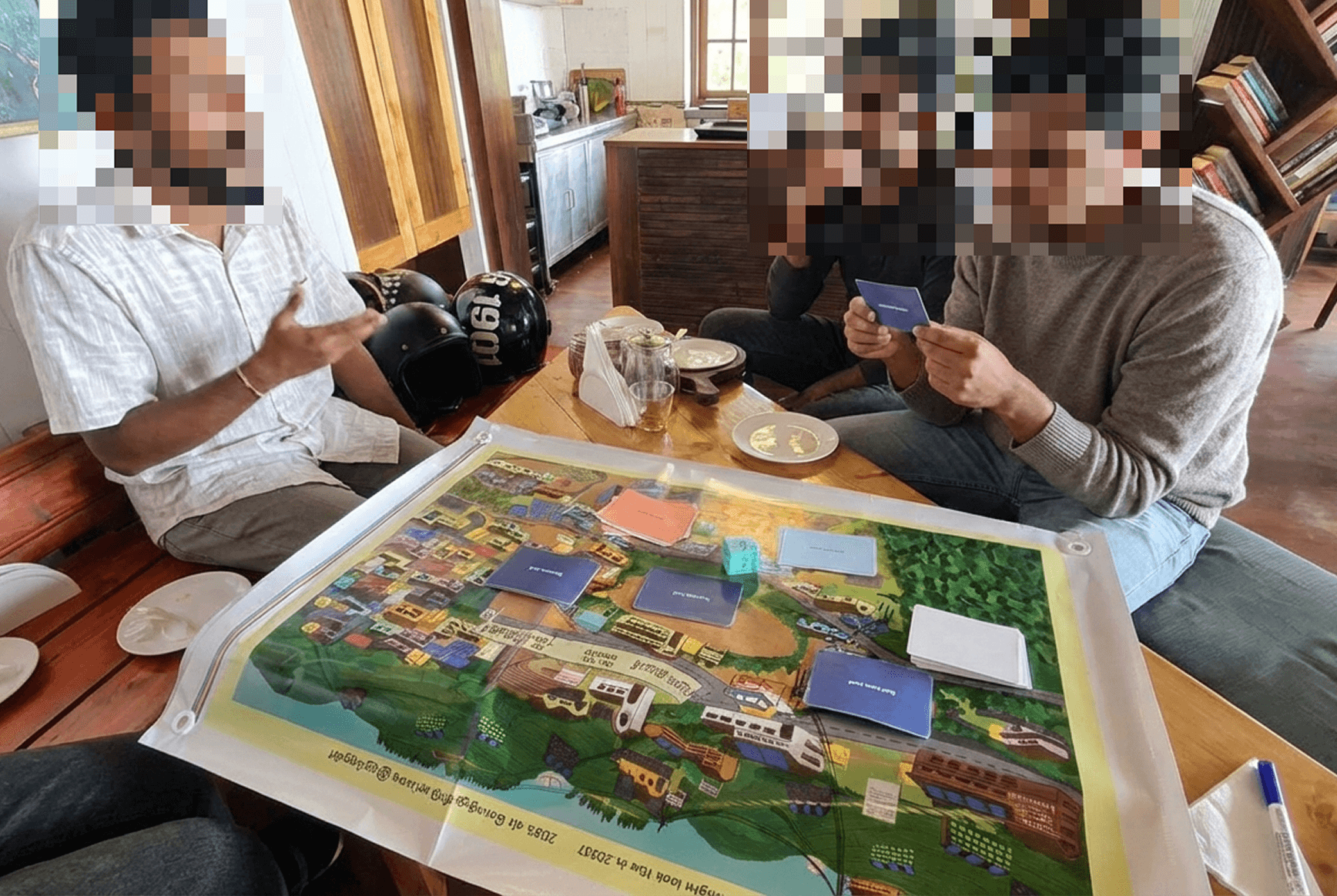
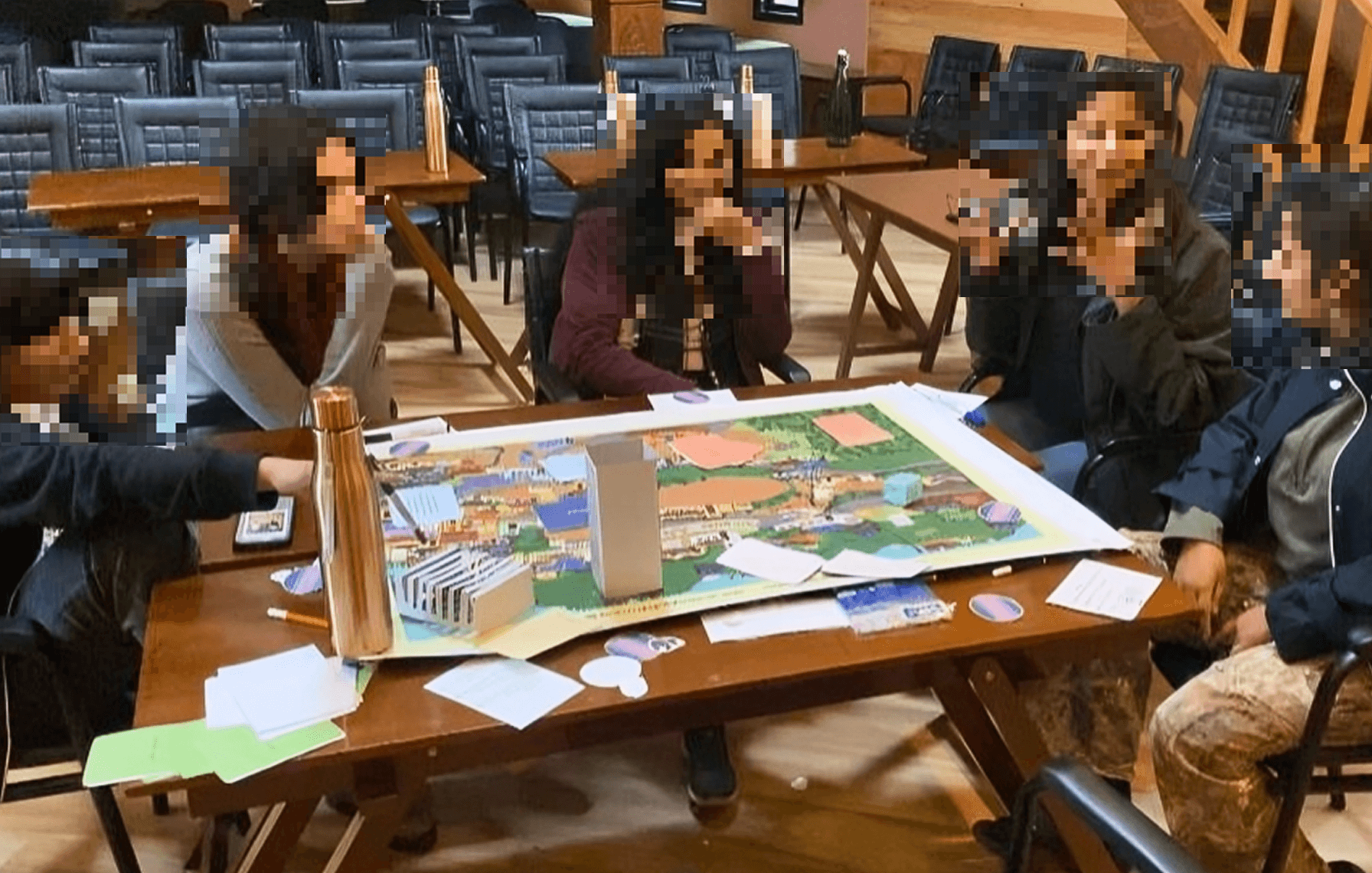
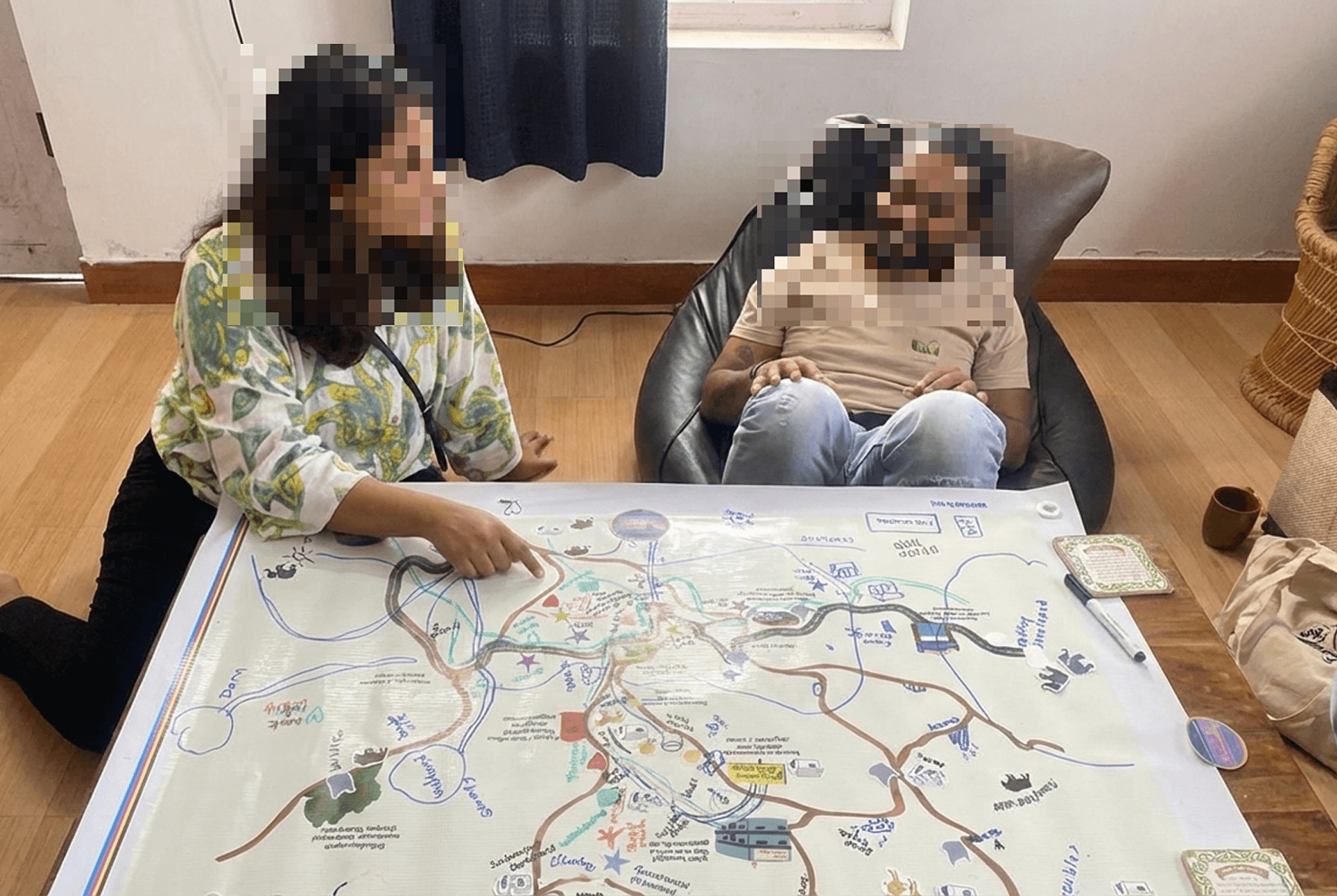
Workshops hooked people fast, all of the sessions ran 2.5 to 3 hours. The mapping exercise felt intuitive and very engaging: participants spotted real concerns in their own spaces, reasoned through trade-offs, then sketched future paths. It built curiosity and ownership organically, everyone wanted to mark up their world.
Development cards landed differently per group, shaped by lived experiences of past struggles, future hopes. Priorities diverged at first. But as scenarios unfolded, talks converged on collective well-being. The flow was natural, reflective of how people actually navigate change and reclaim agency.

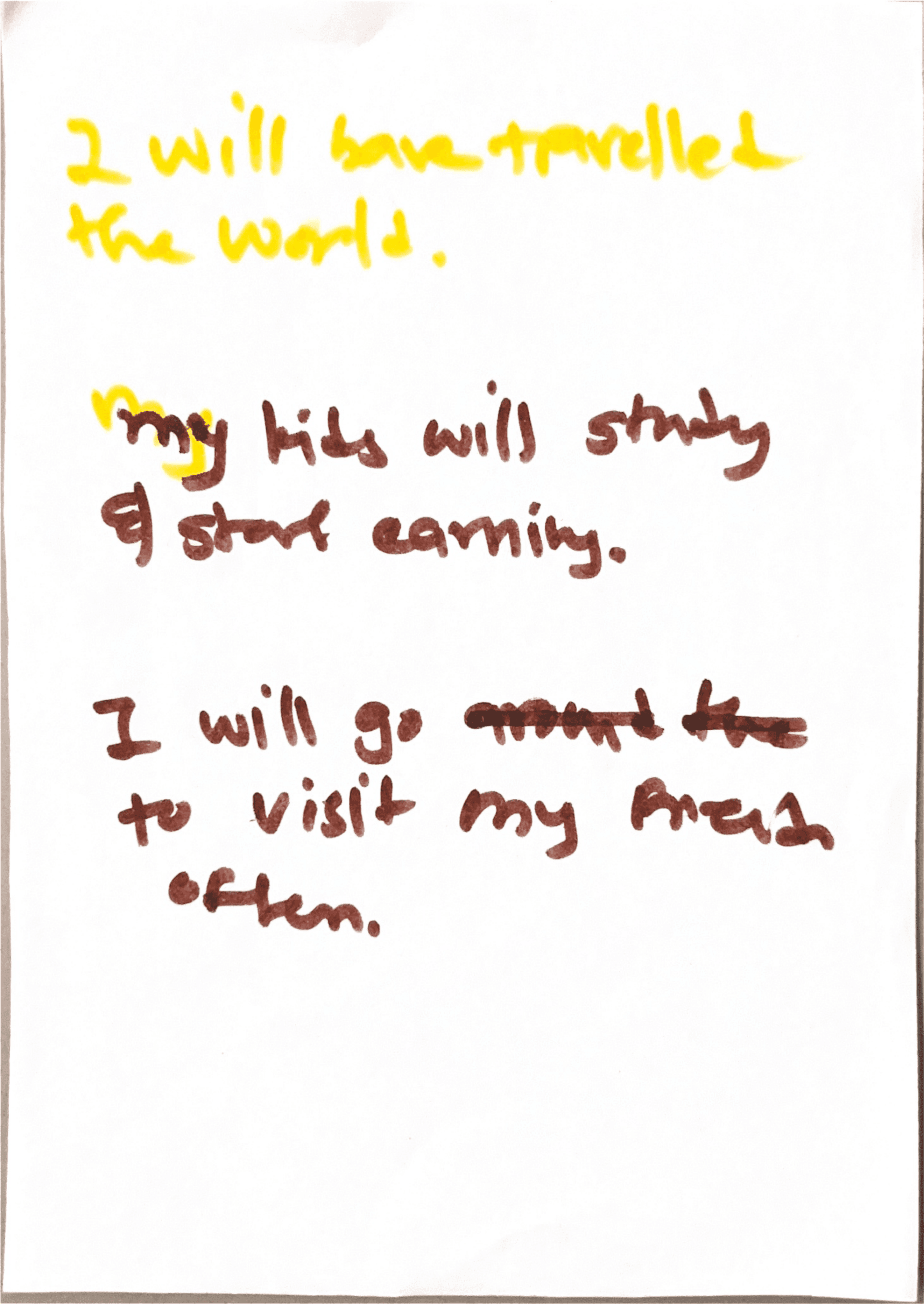
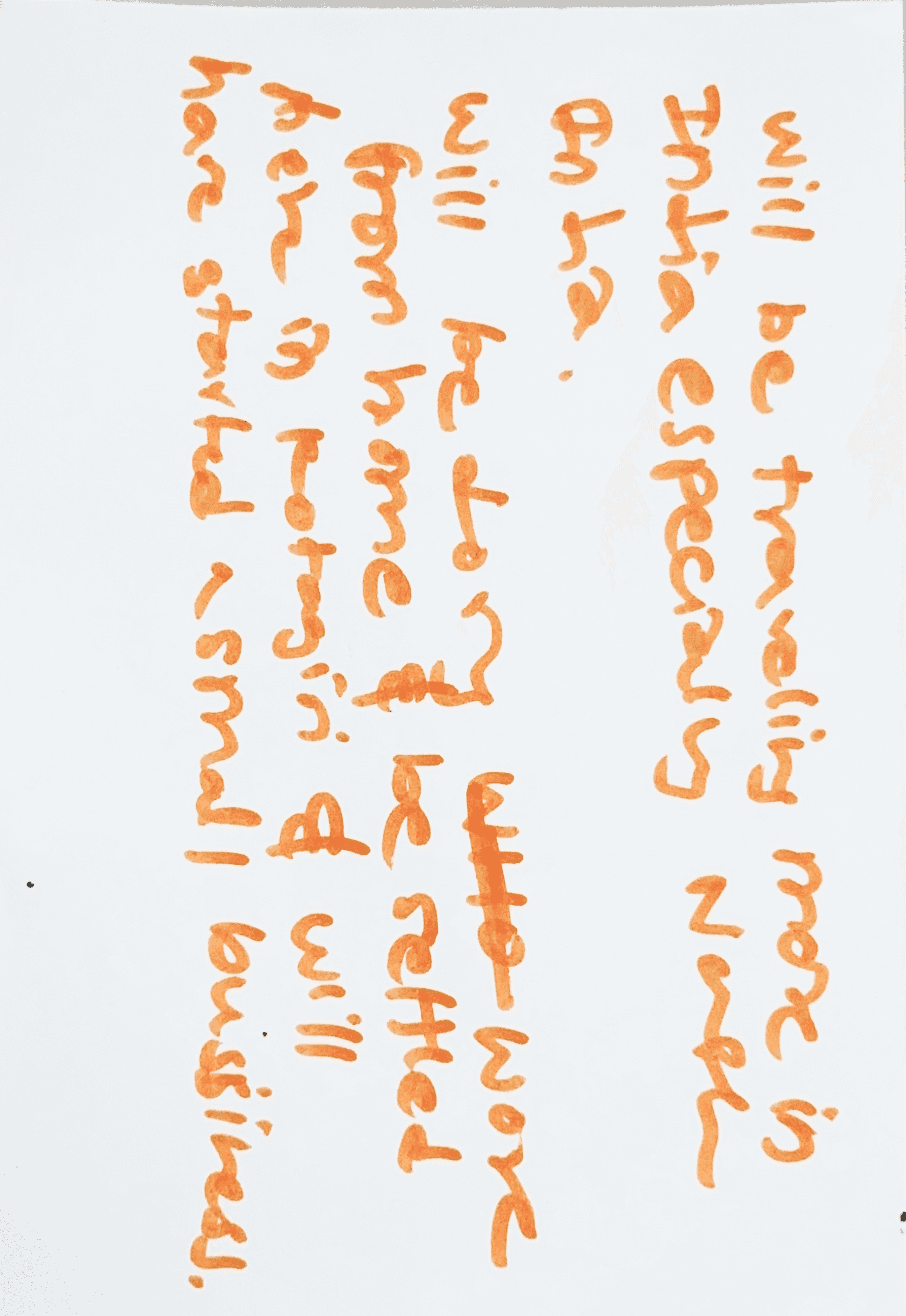
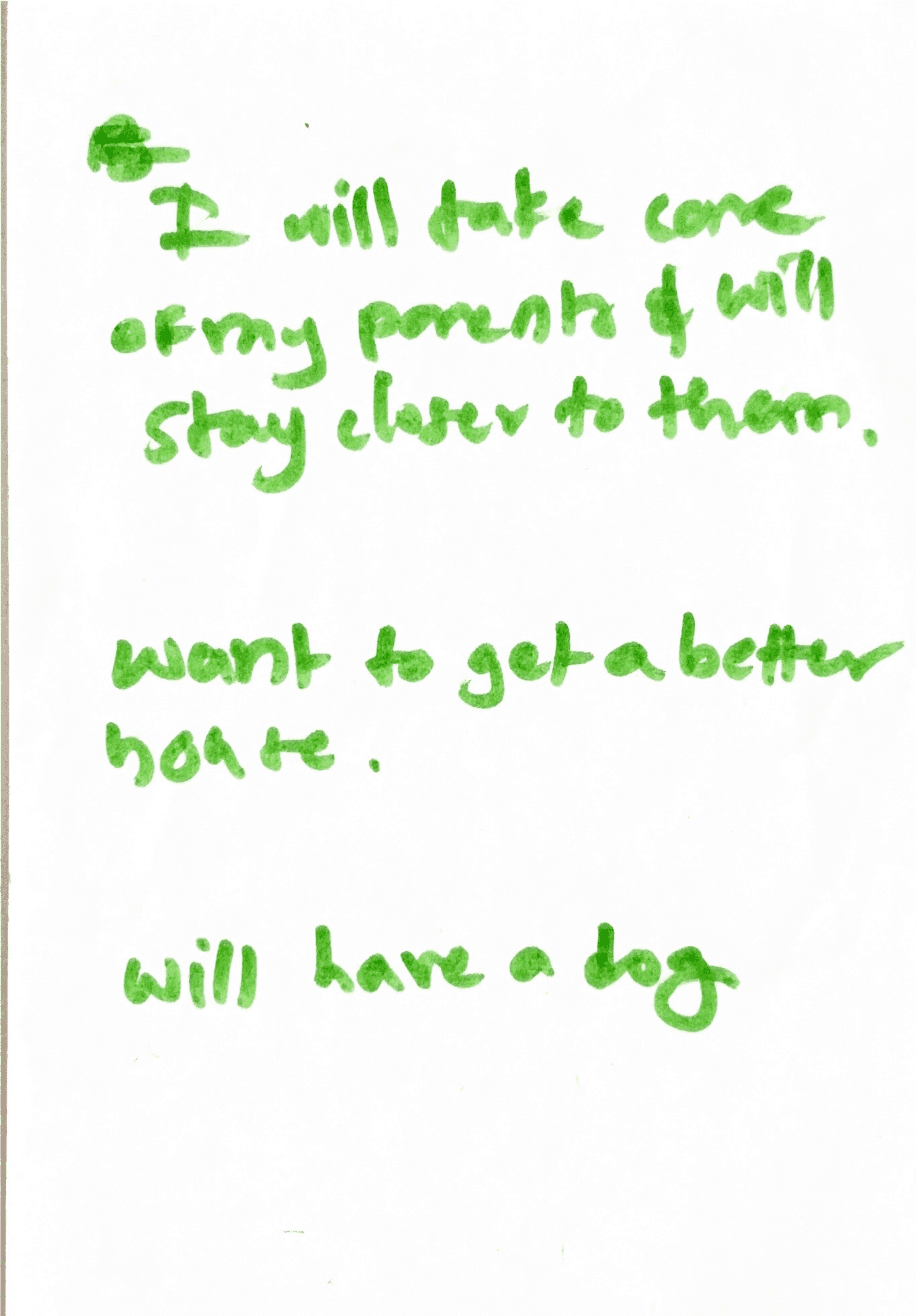
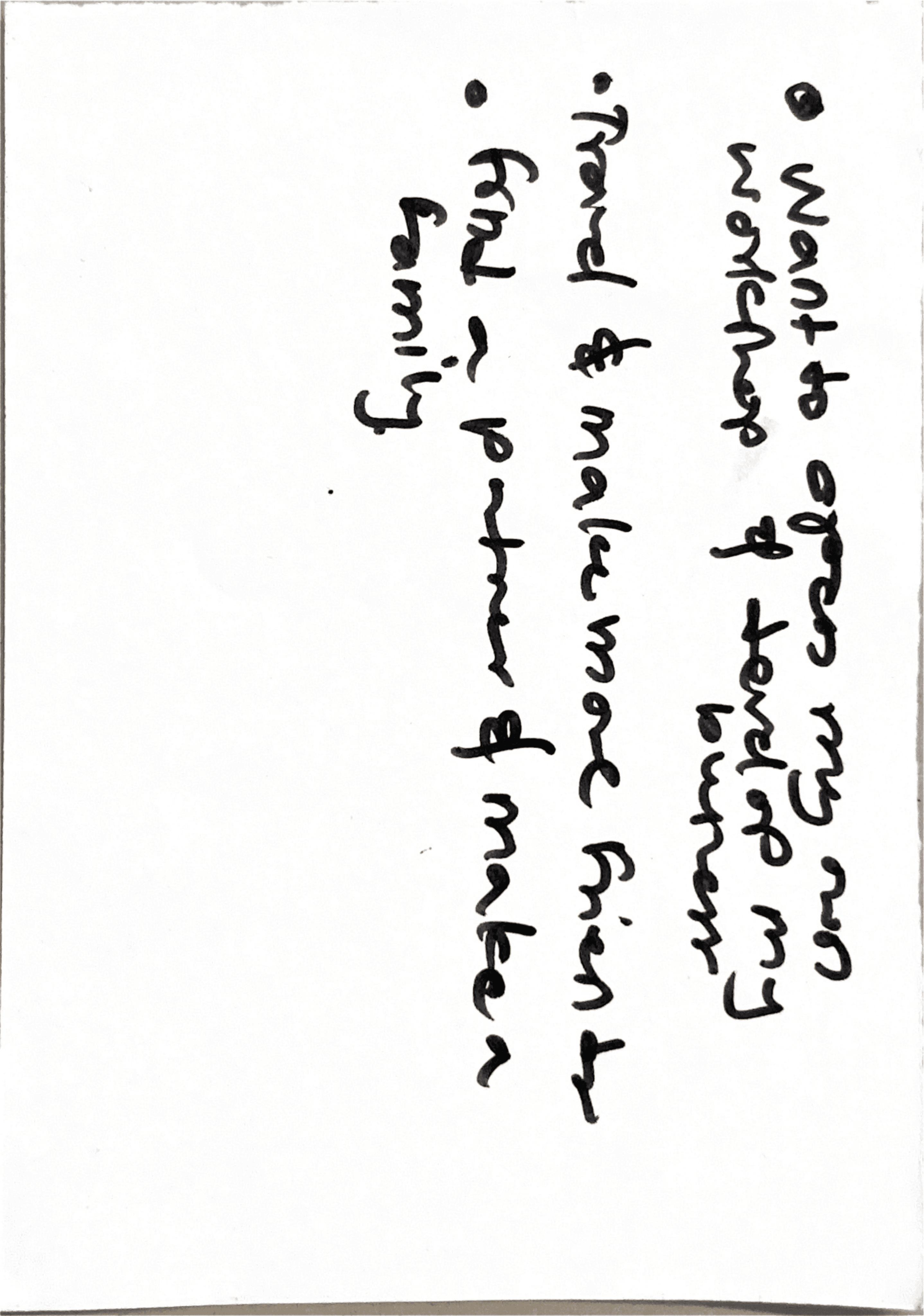
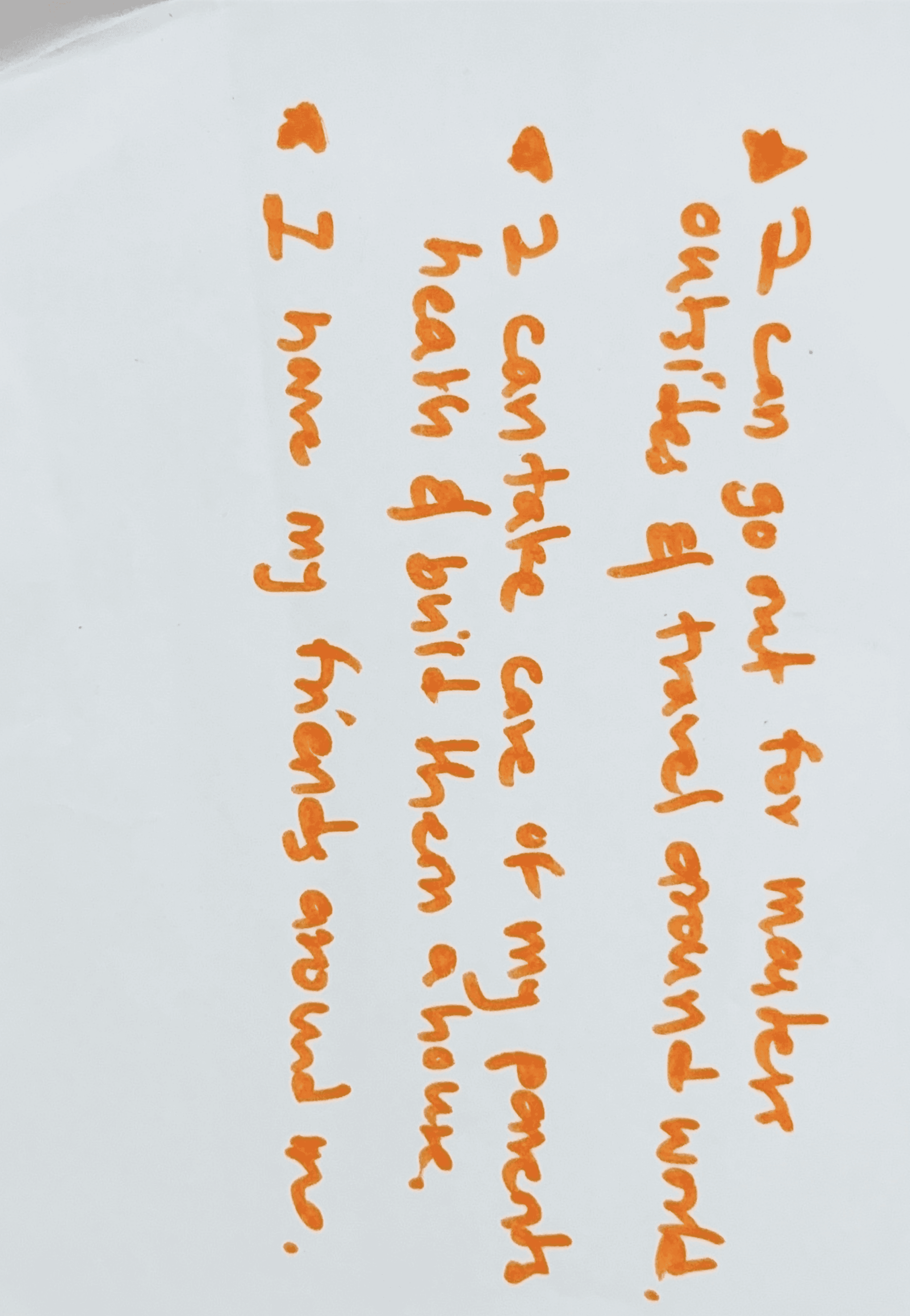
Where do they think, they will be in 10 years?
Before entering the future of kotagiri 2035, we tried yes and prompt where the participants shared a speculation of what can happen in kotagiri in next 10 years. These prompts also suggested a deep uncertainty of what can happen and lack of agency towards the futures but it become a space to voice their fears.
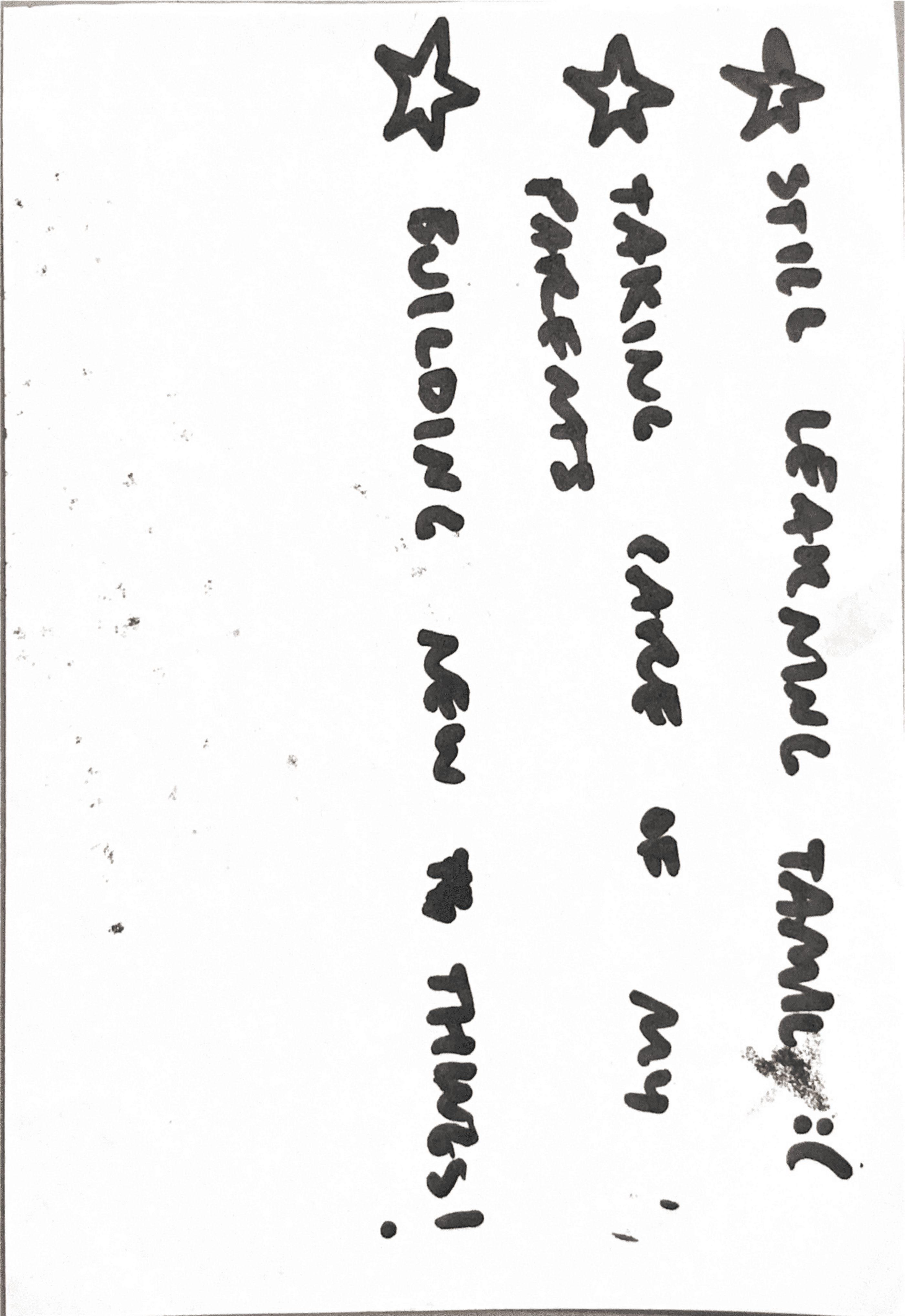
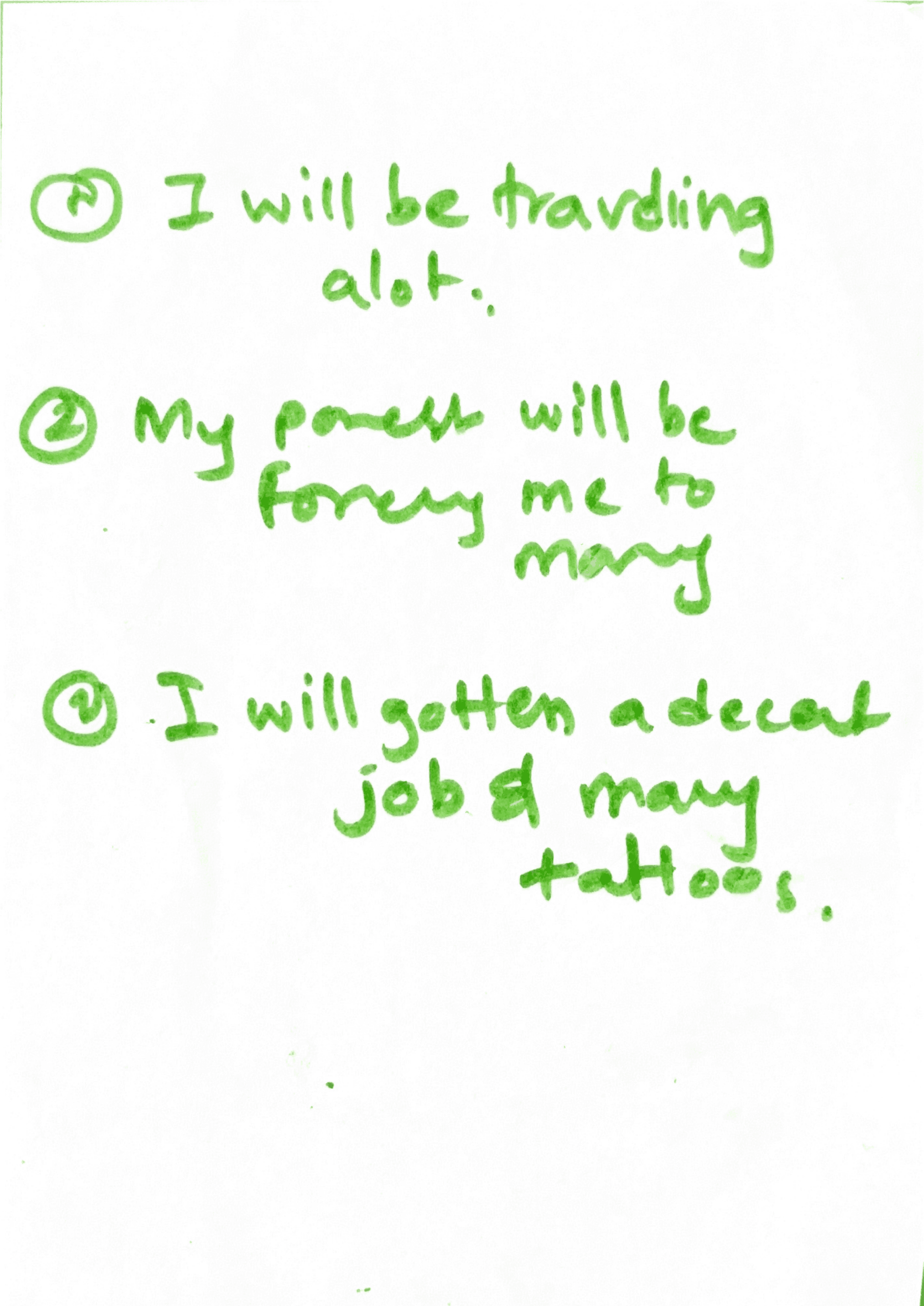
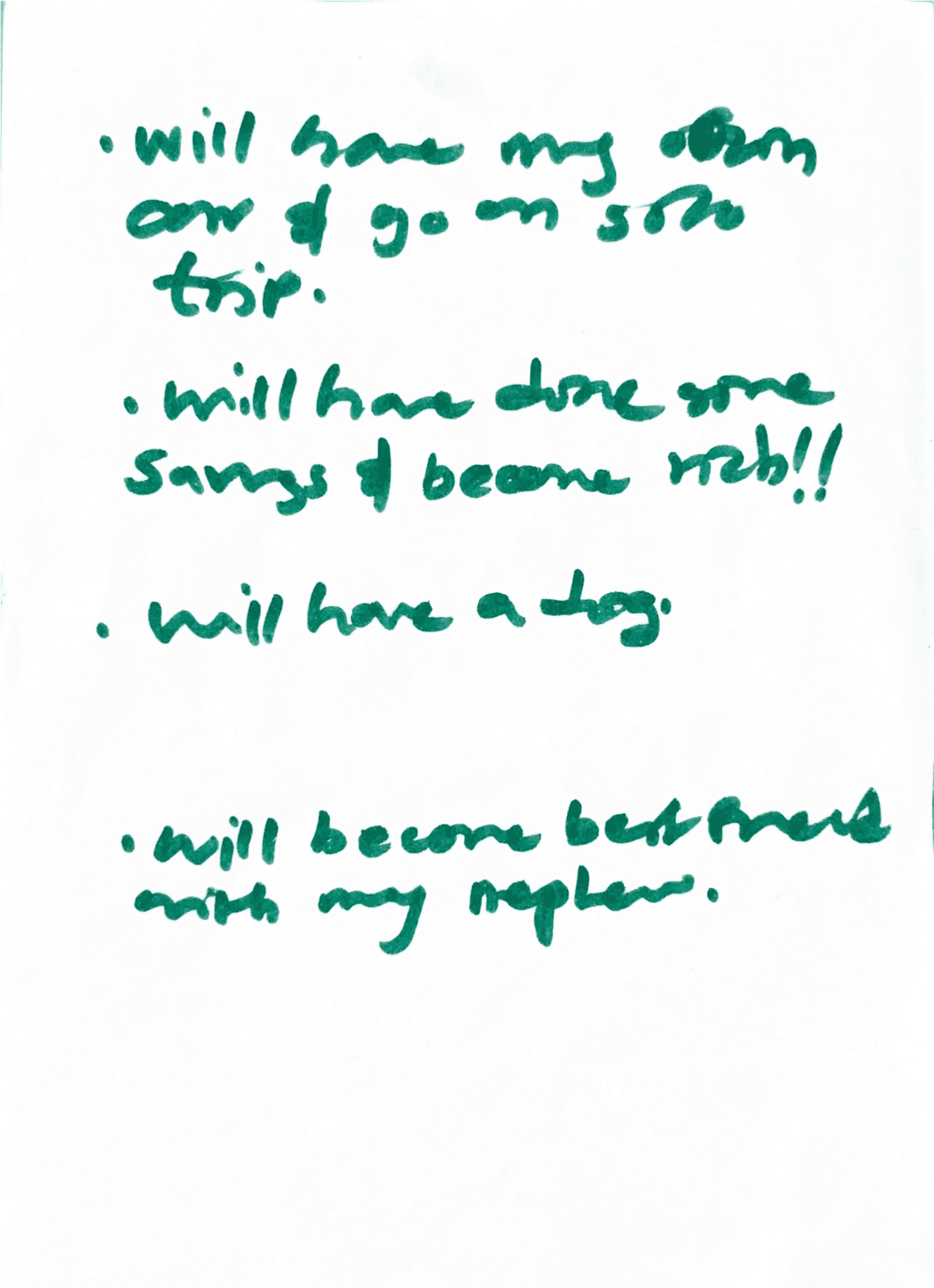
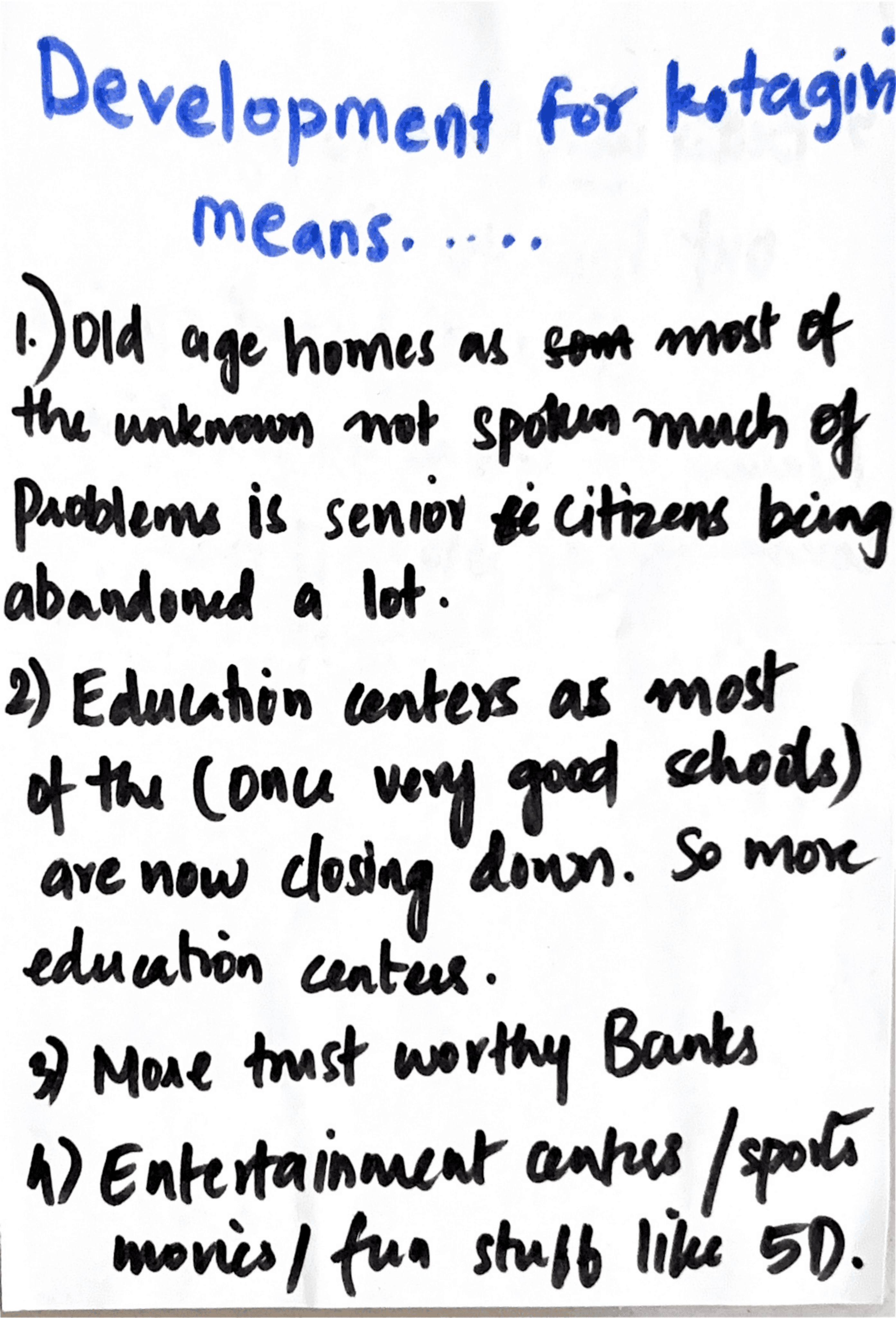
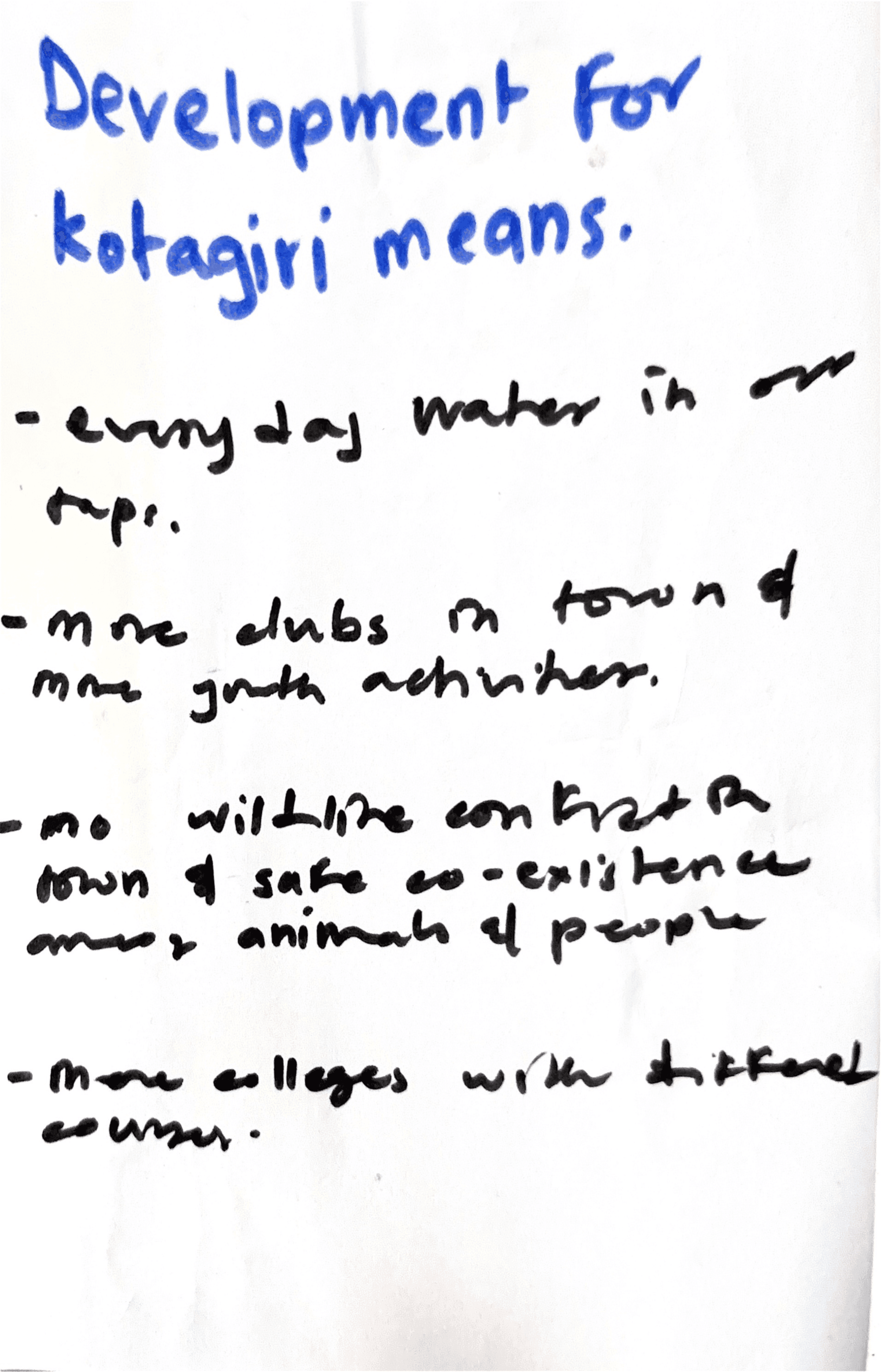
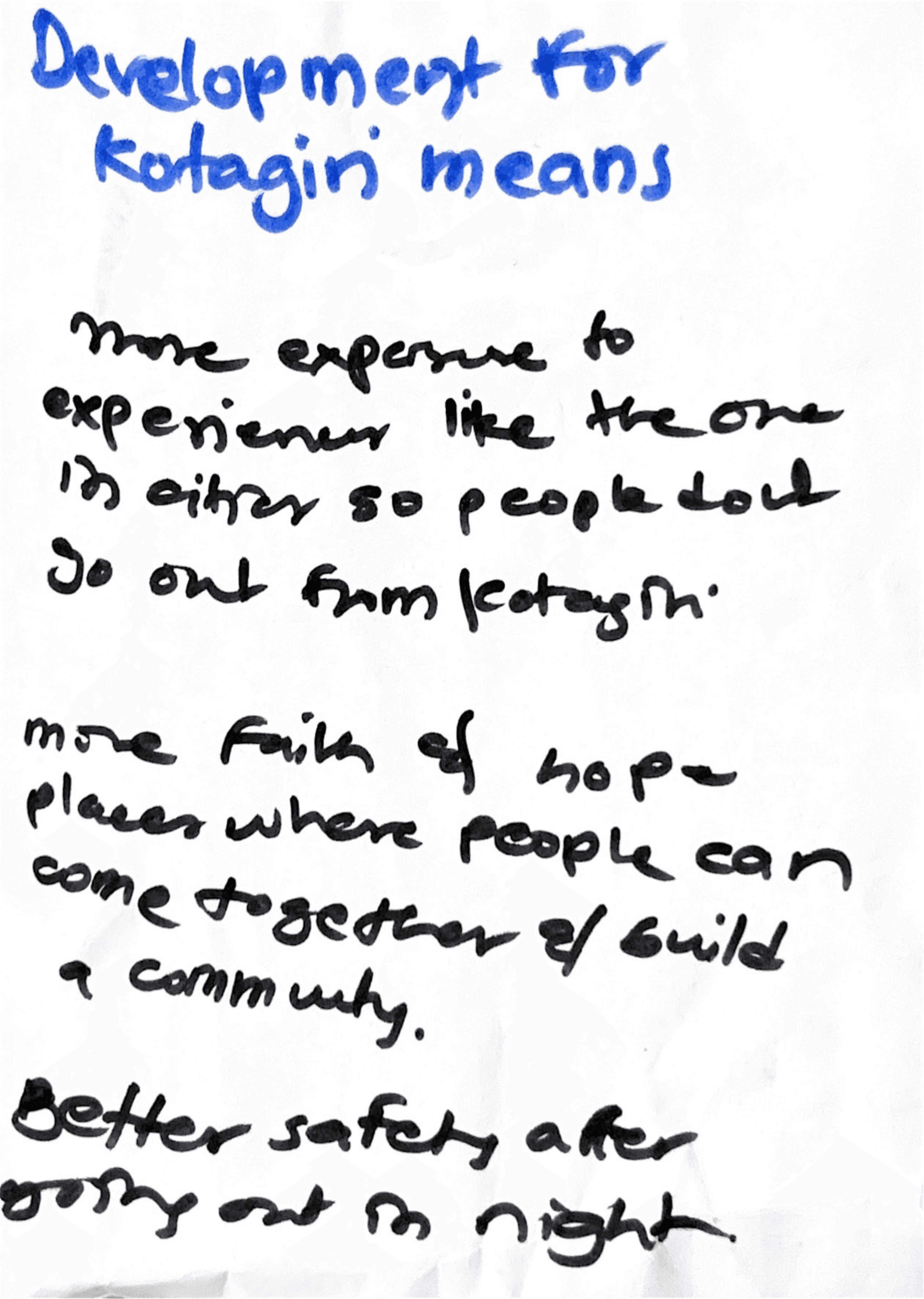
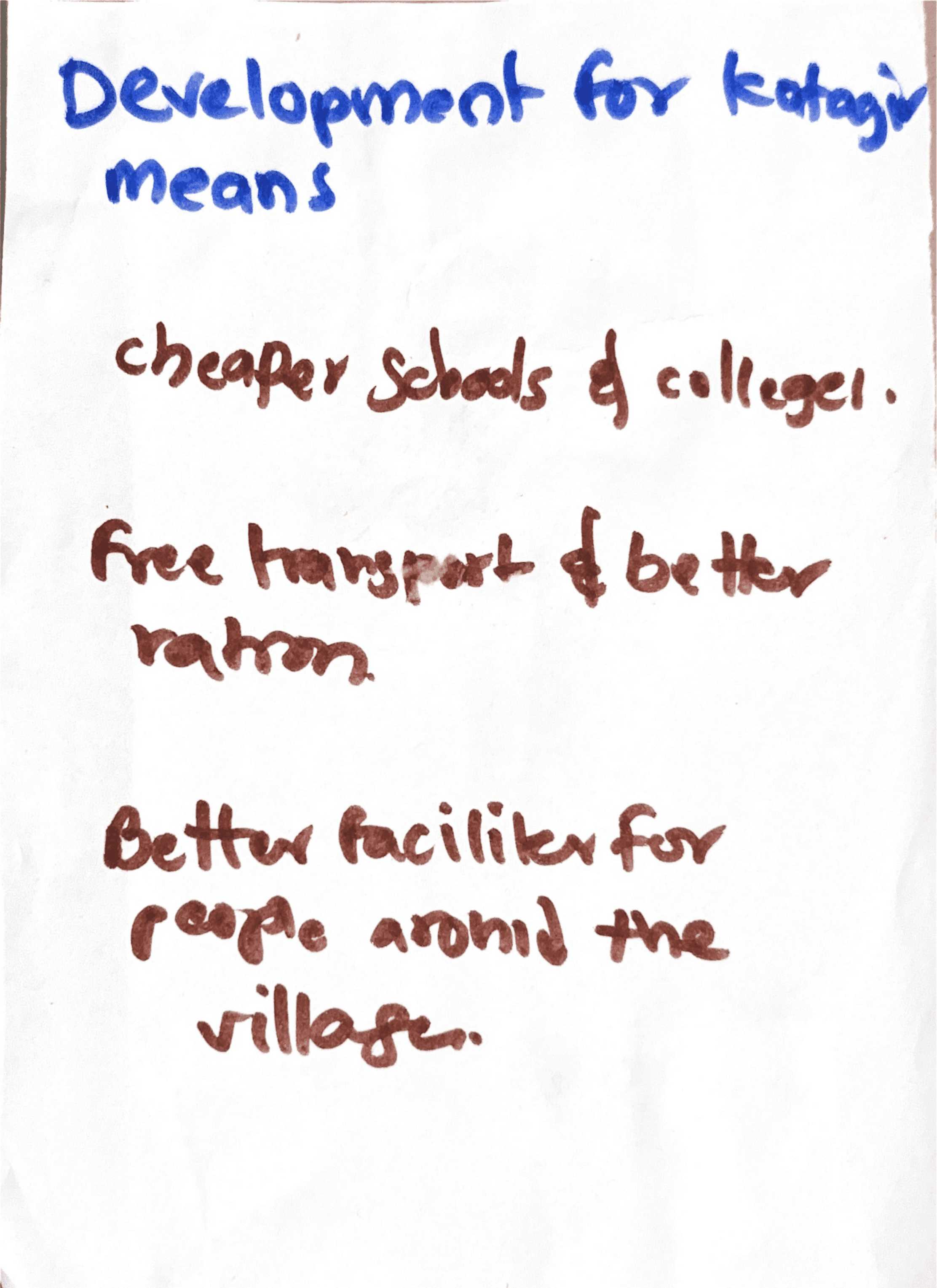
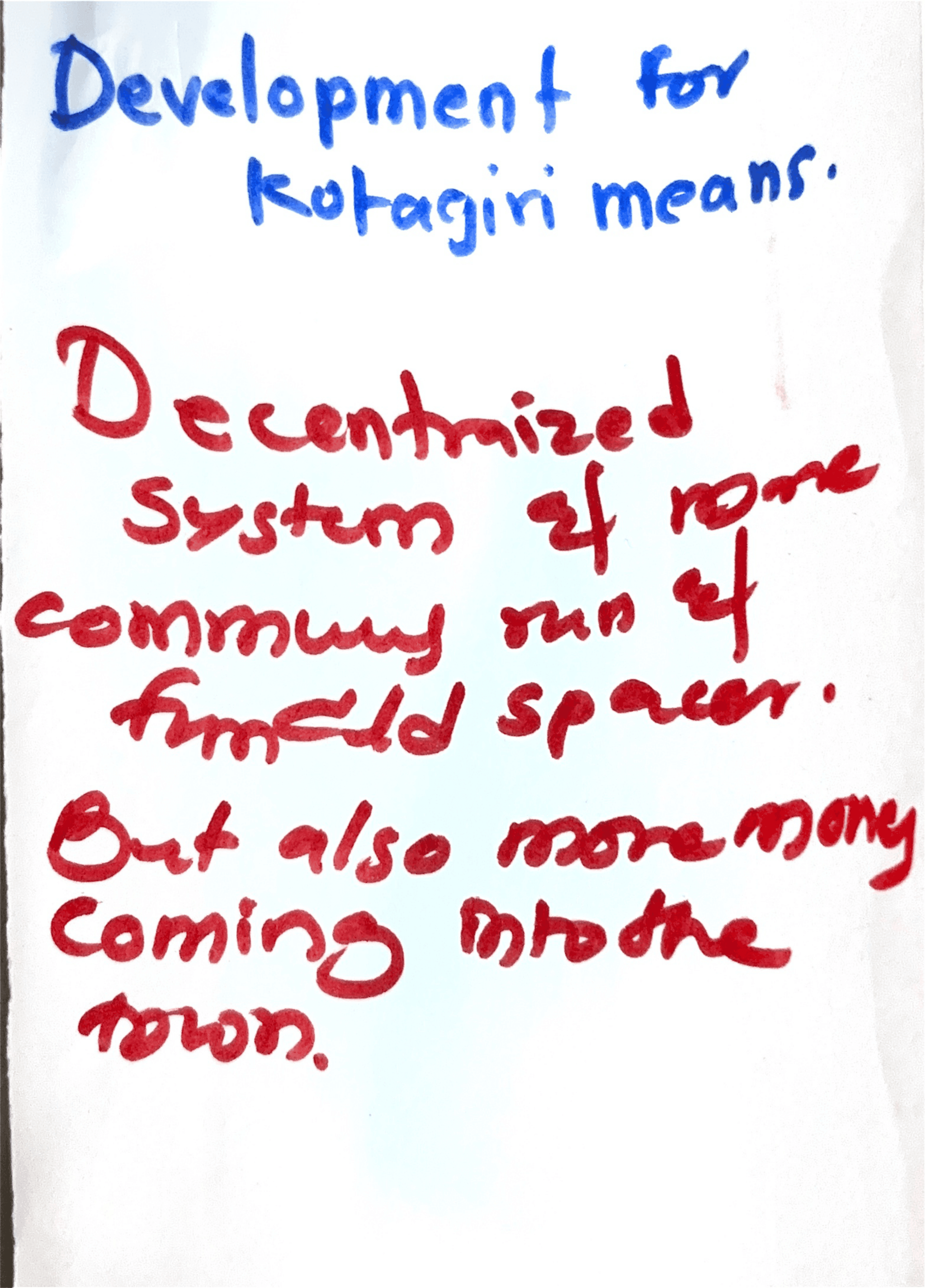
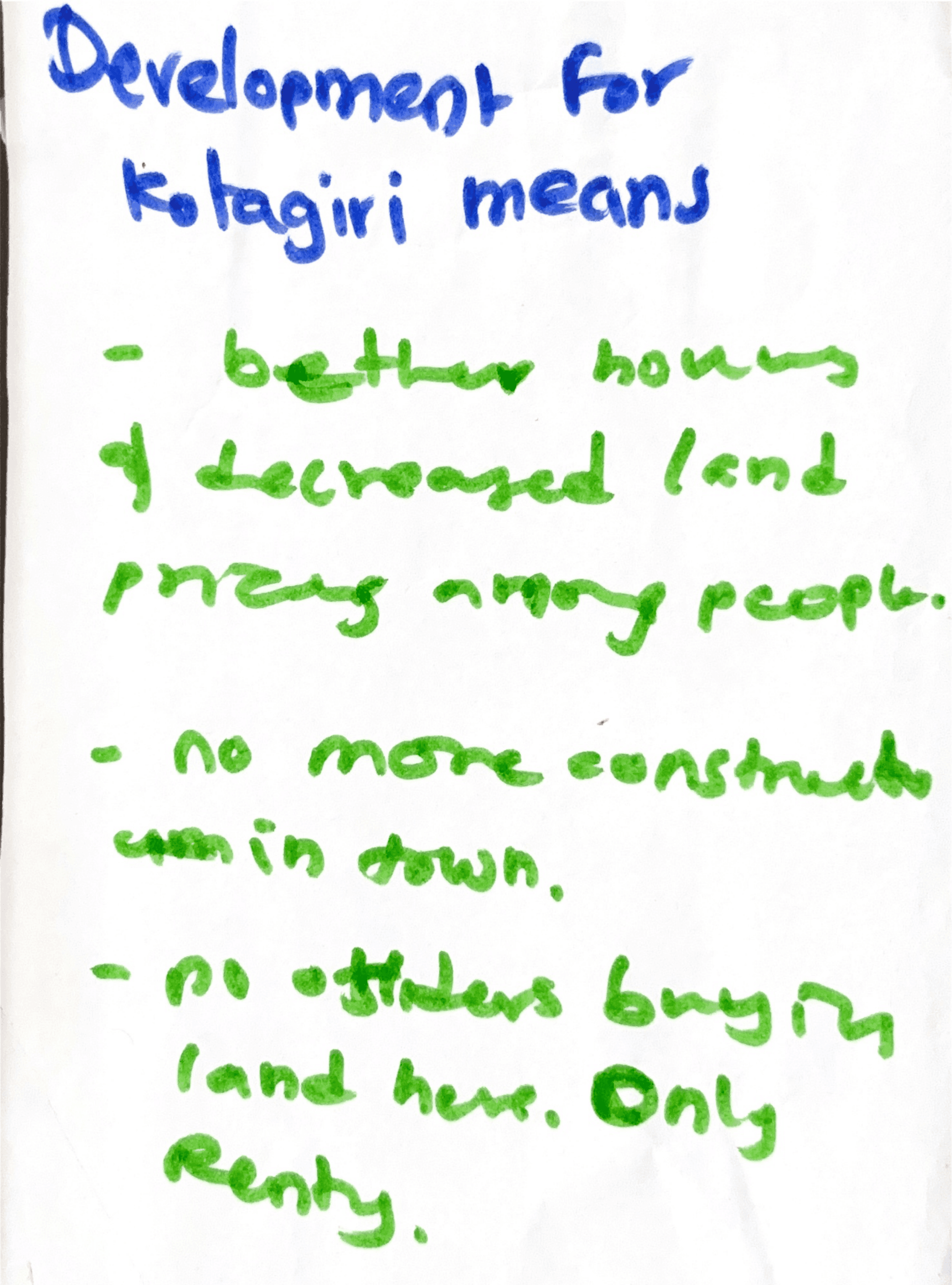
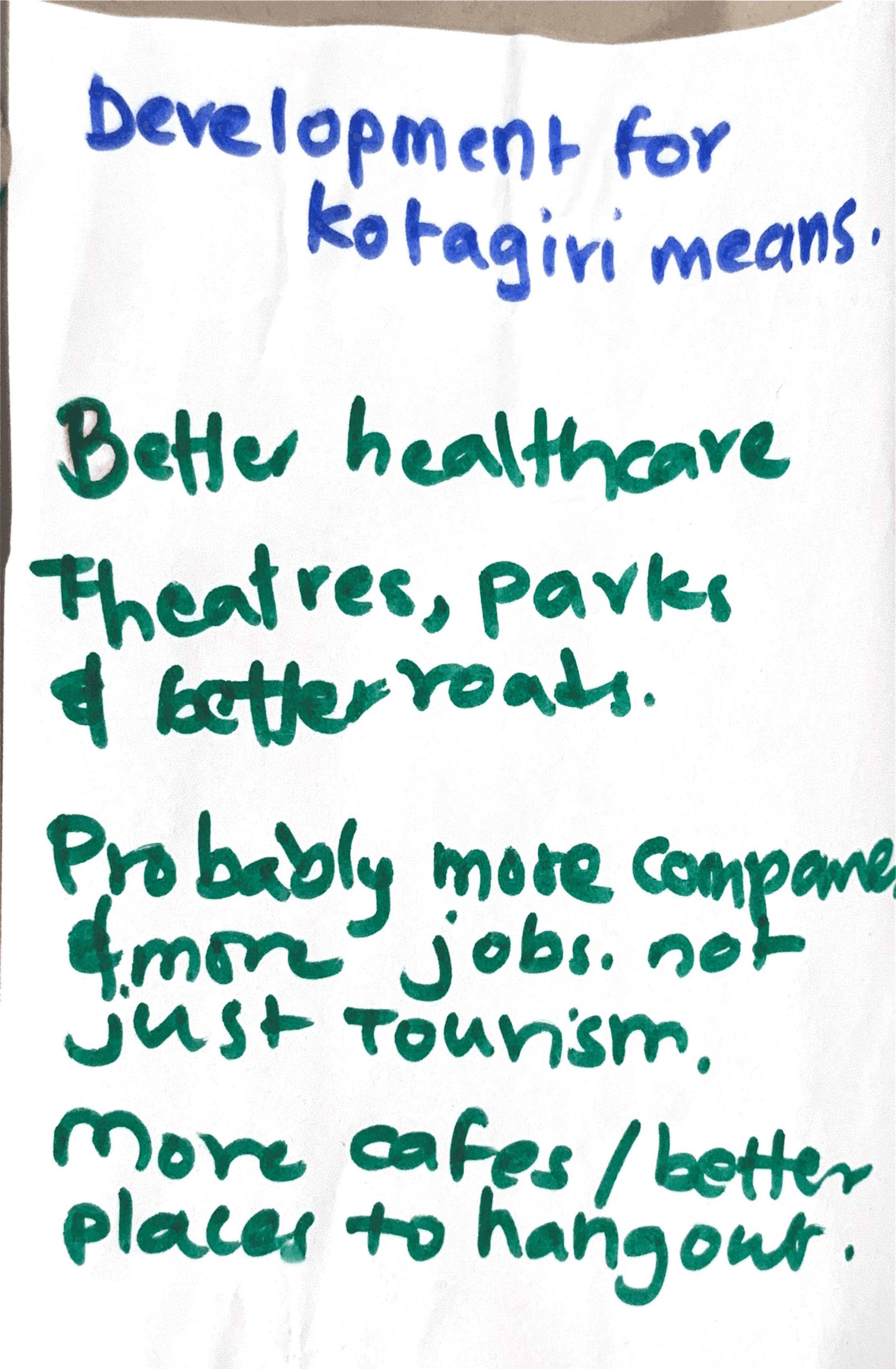
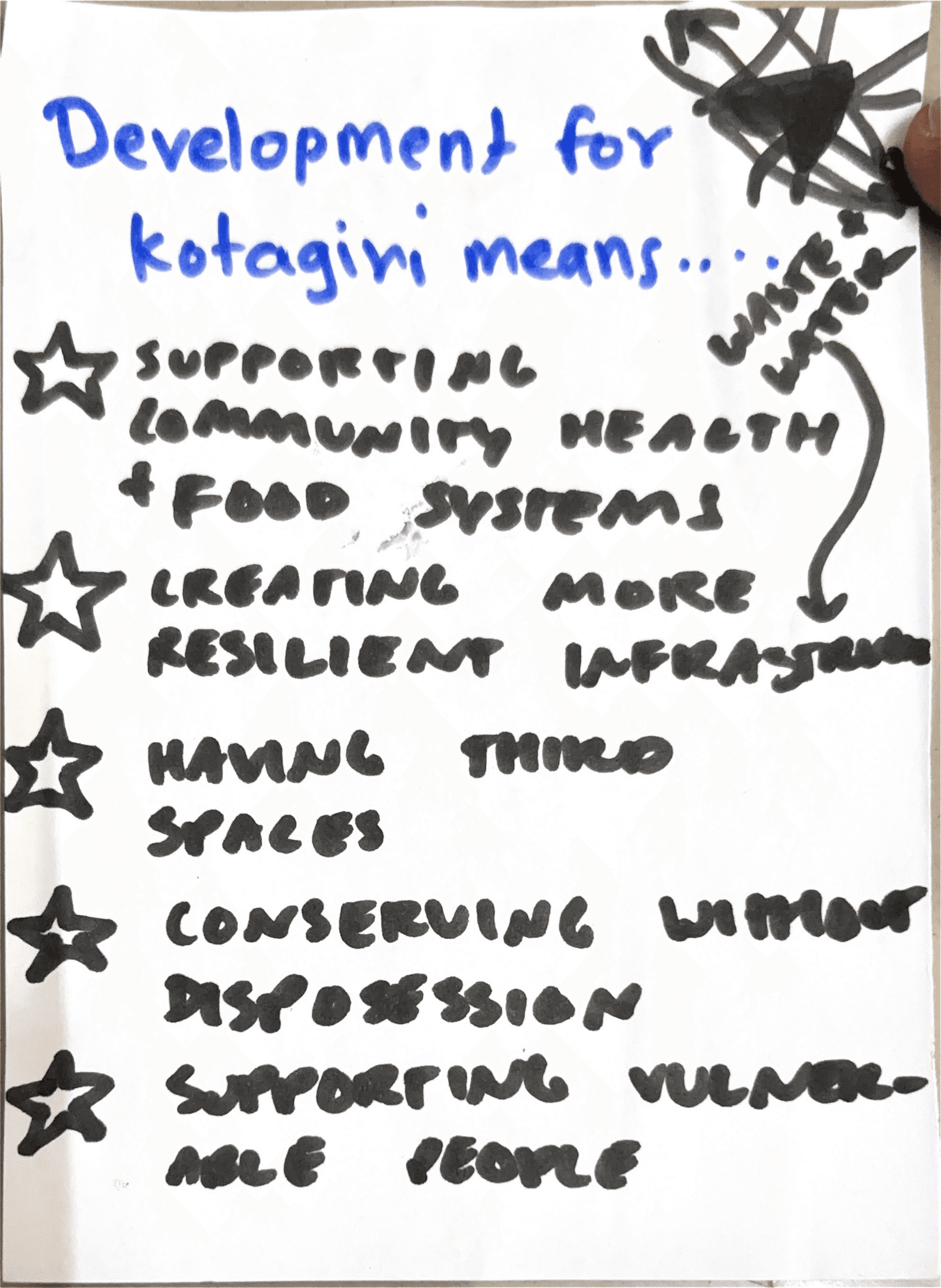
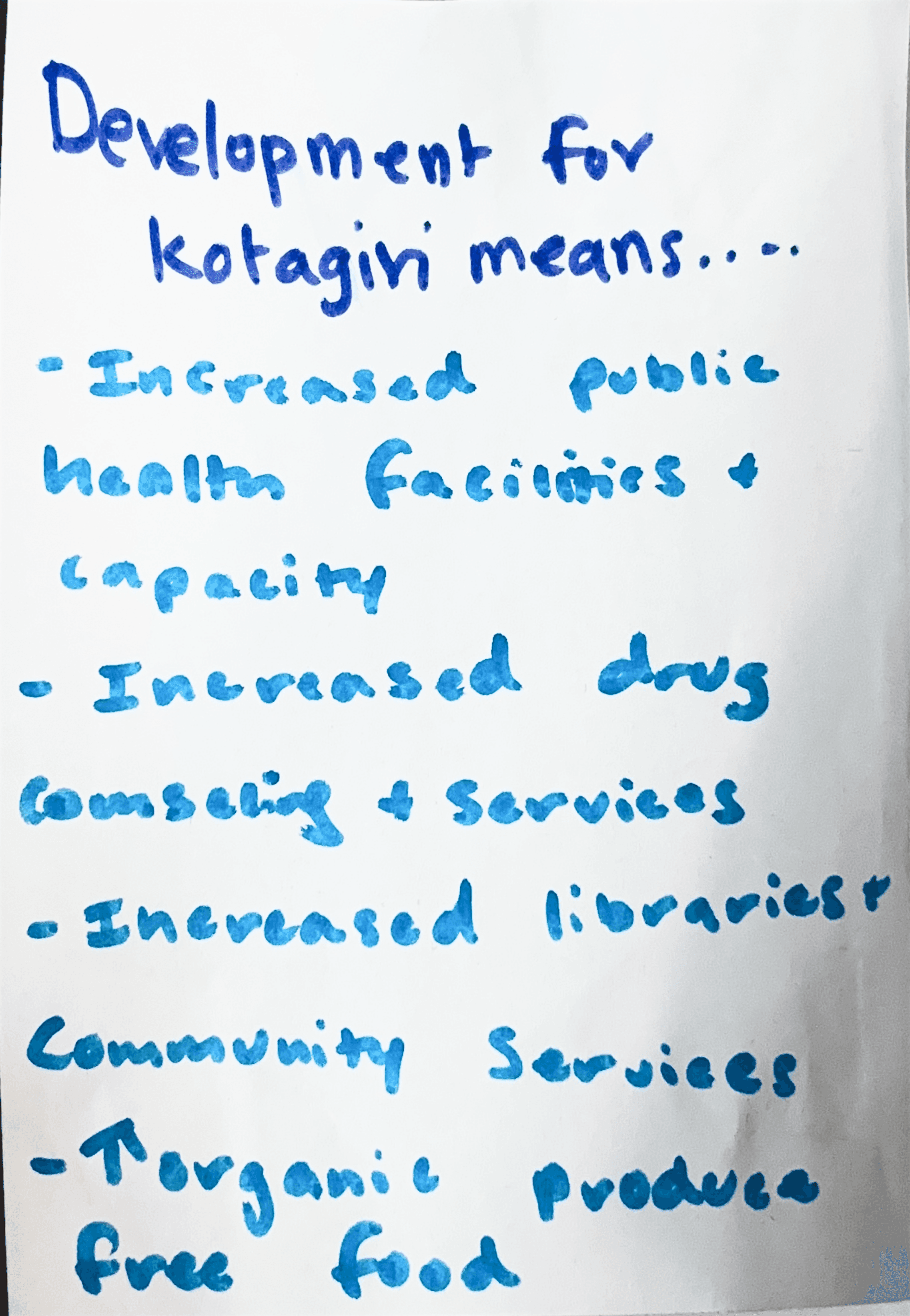
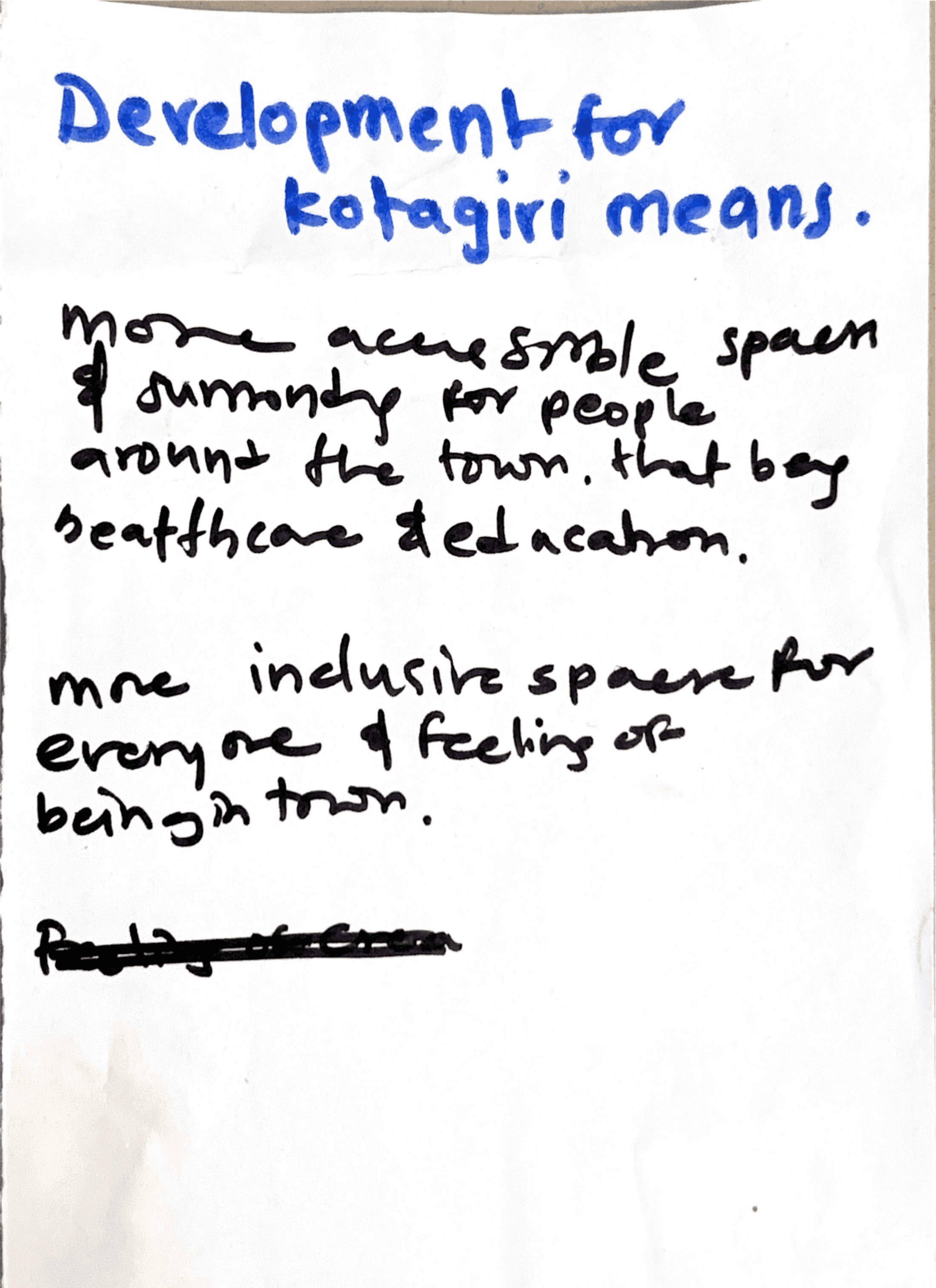
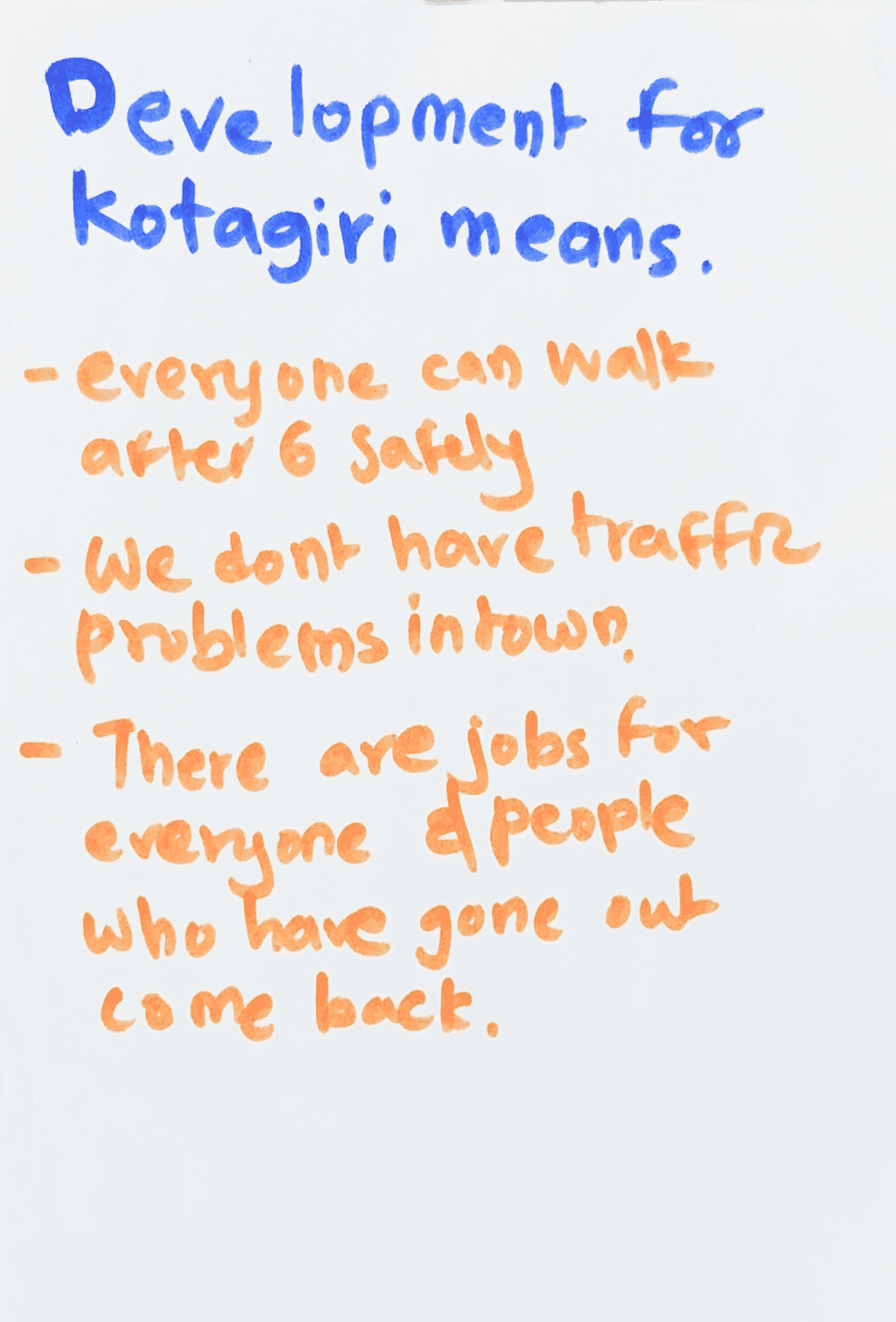
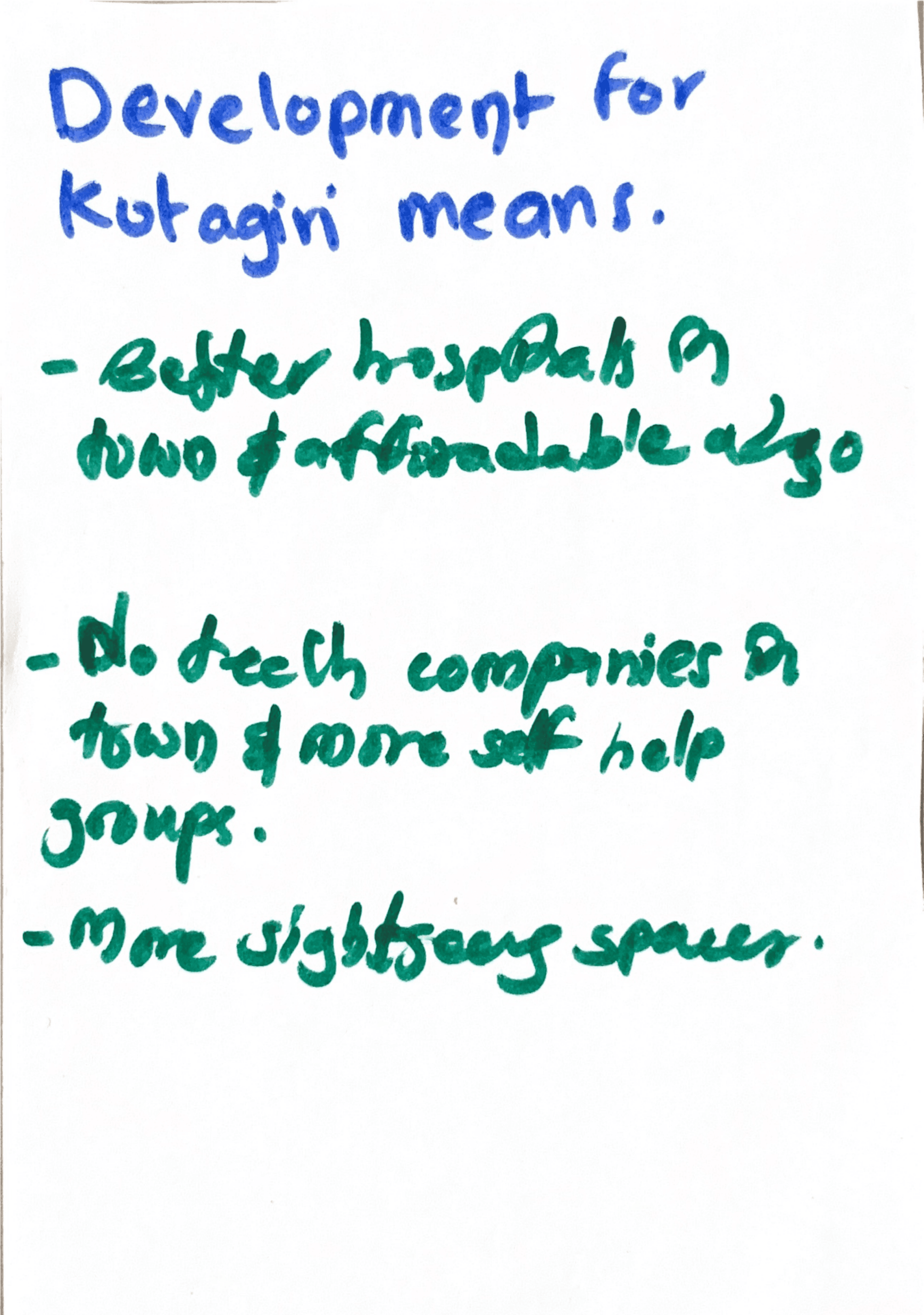
What does development mean for kotagiri then?
At the end of the session, the participants, reflected and shared their ideas of what development means for kotagiri. These reflections lie at the core of the envisioning.
Feedback and Metrics from the workshops
After each workshop, we stepped back, talked through what worked, what didn't. The prompts, the flow, how complexity landed. As we plan to take this to schools and colleges, we're testing new ways to make it engaging, simple yet not diluting the complexities for a younger audience.
"What if there were cards that matched the map but each with different resources and impact written on it ? May be people see and make different variation, it might bring deeper conversations."

May be the development cards will have certain point systems to help direct the impact and benefits?
May be the development cards will have certain point systems to help direct the impact and benefits?
"What if we drew characters from the map—showed a day in their lives in 2035? Used their own stories from the workshop. Let them see themselves in the future."
"What if we could take something home, something that stays with us, keeps reminding us of the future they actually want?"
"What if we could take something home, something that stays with us, keeps reminding us of the future they actually want?"
What People said
Whats Working?
Mapping exercises have proven to be an effective icebreaker and high-motivation starting point.
The storytelling elements generated a sense of curiosity and excitement, which brought them away from hopelessness.
Mapping their hopes and ideas before and after the workshop provides valuable evidence for them to observe change.
Whats not Working?
The barrier and enabler cards do not work for some cards, resulting in dead ends.
The impact of previous development cards is not immediately apparent in the following rounds.
Erasing previous workshop sketches from the map because they all led to the same ideas.


Learning Objectives Parameters

Surface
Description
Critical Cause
Description
Ability to recognize Cause & Effect Relationships

Ability to Map Reasons for Challenges
Capacity to Negotiate divergent Priorities
Ability to Imagine Divergent Futures
Aspect of Hopefulness about future
Structural
Reasoning
Problem Listing
Non-Engagement
Limited Pathways
Pessimistic Futures
Different possibilites
Optimistic futures
Systemic Negotiation
Pessimistic Futures
Optimistic futures
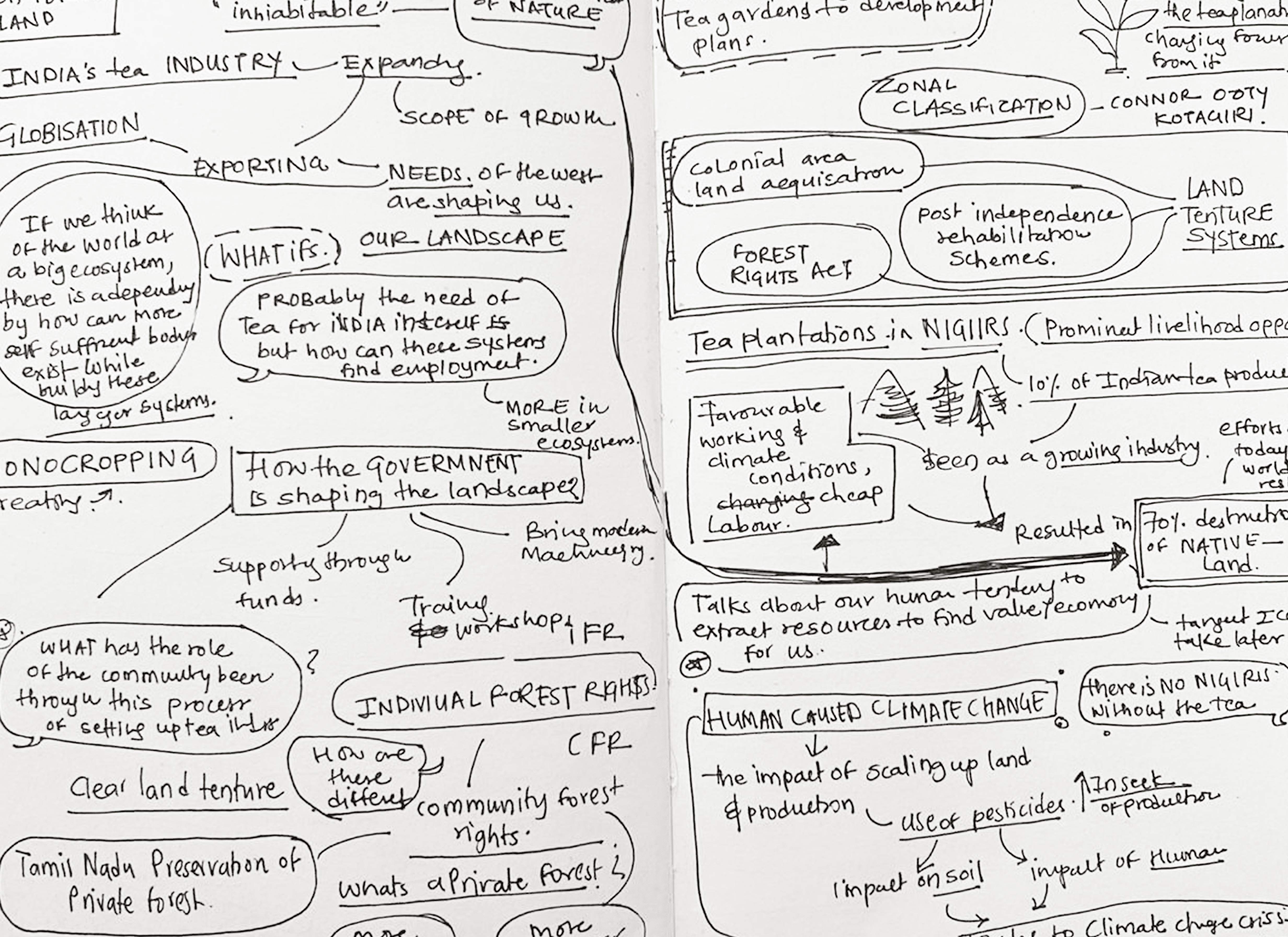
Thematic Mapping out of the conversations
The various concepts that emerged from the talks and workshops were then organized into several themes of transformation and progress. These also serve as a powerful testimonial to the deeper aspirations that respond to larger systems.

Theme 1
Need for Third Spaces
This theme moves the emphasis from increased infrastructure construction to more locally used areas and infrastructure. It reimagines empty or underutilized places as recreational hangout locations, and public spaces such as parks, community halls, club houses, and theaters at an affordable cost, making them truly accessible to all. It comes from a place of fear that their own town is being built for others rather than for their well-being.
Way forwards
Policy should require community-managed "Third Spaces" which can be crowdfunded by local businesses or government funding.
Theme 2
Sustainable Livelihoods
This theme sees Kotagiri as a place that can provide young people with sustainable livelihood opportunities rather than pushing them to migrate in search of employment. It discusses vocational training suited to the local socioeconomic circumstances in order to combat inflation and debt cycles. Rising expenses and a shortage of high-paying jobs in the existing livelihood opportunities.
Way Forwards
Establish "skill incubators" that partner with the private sector to offer career counseling and internship pathways specifically for local Adivasi and Nilgiri youth.
Theme 3
Civic Literacy and Dialogue Forums
This theme addresses the gap between the community and local governance. It thinks to start young civic literacy programs and formalized spaces for complaint and dialogue, ensuring that "agency" is a practiced right. A widespread feeling come from being unaware of decisions/policies or even knowing how to engage in the decision-making process.
Way Forwards
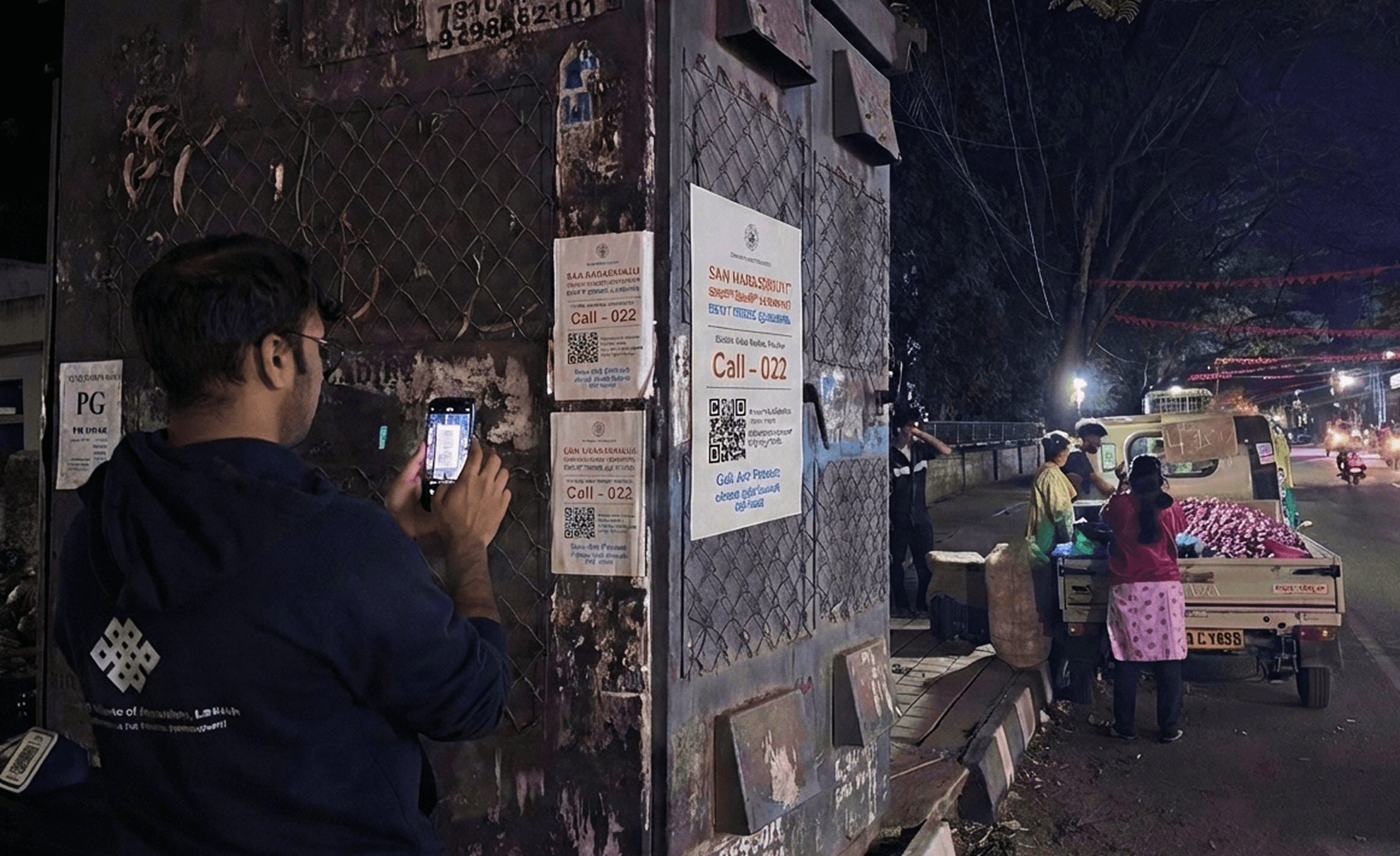
Integrate civic fellowships for teens and use QR codes/toll-free numbers to make government services and dialogue forums accessible to everyone.
Theme 4
Equitable Infrastructure and Wellbeing
This theme focuses on "Redistribution" as a tool for social justice, specifically addressing the underpaid labor like tea estate workers, asha workers and so many more. It reimagines public services, like healthcare and waste management as reflections of community care. The observation come from, that public infrastructure is often understaffed or overwhelmed, leading to worse care for the most vulnerable.
Way Forwards
Formalize economic and logistical support within community infrastructure and regulate private finance to break the "debt cycles" that create intergenerational poverty.
Hover over the cards to learn about the divergent futures!
Way forwards
The workshop is still in its early stages, so there are several options for moving forward, the first of which is to reiterate the map that aligns with community interpretations and ideas, as well as to make their futures visible. The workshop works best when it is played and tested with larger groups, resulting in a living archive of futures and a testimony for the positions of power. The objective is to take these findings to the local municipality and explore how these various futures can be achieved.
Creating smaller versions of the workshops, maybe a small activity which then can be the starting point. Not everyone will have the time to invest 2 hours in the workshop directly.
Maybe we can partner with the climate change team at keystone and do sessions with different school students across the town?
Creating like small publications which documents these futures and that way it can be also placed in the local library.
We can do like sessions with different age groups - from churches, colleges and constantly iterate on the workshop.
Reflections
Co-creation is not how
easy it looks!
Co-creation is much harder than it looks on paper. I used to think of it as a simple path to participation, but this project showed me how much logistical support and personal investment it actually requires from everyone involved. It isn’t always ideal or easy, and there are so many factors you just can’t control. I’ve learned to aim for "co-agency" instead, finding real, honest ways for us to act together, even when the process feels imperfect and heavy.
Futures thinking is the tool for the present
speculative design doesn't mean ignoring the problems we face today. Imagining the future isn't an escape from the present; it’s a tool to look at it more clearly. By thinking about what might happen, we can realign how we deal with the challenges sitting right in front of us. It is a method that uses the future to help us make sense of the "now" and the uncertainties we are currently living through.
Remembering "Why" through every pivot
Pivoting and changing direction felt like the only constant in this project. I’ve learned that reiterating is natural and is simply how this kind of work operates. When the discussions got messy and the process felt chaotic, the only thing that kept me grounded was reflecting on my original intent. Constantly asking myself why I started this and what kind of impact actually matters became the guiding force that helped me navigate the mess.
IK, that was a long Scroll !
here are some other projects

We know this is not ideal but the tablet version of this project is WIP!
You can view the project on desktop or phone!
We know this is not ideal but the tablet version of this project is WIP!
You can view the project on desktop or phone!